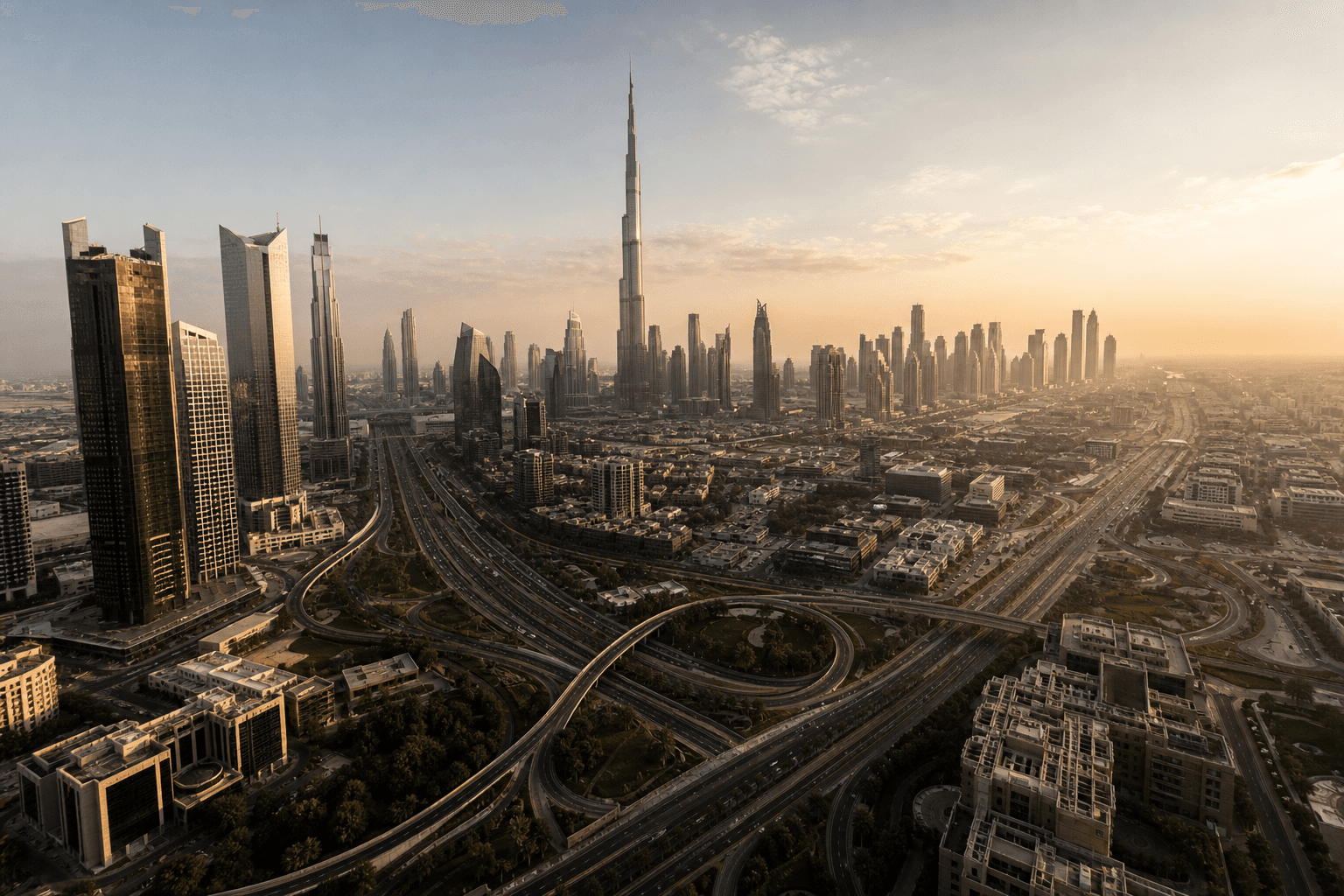
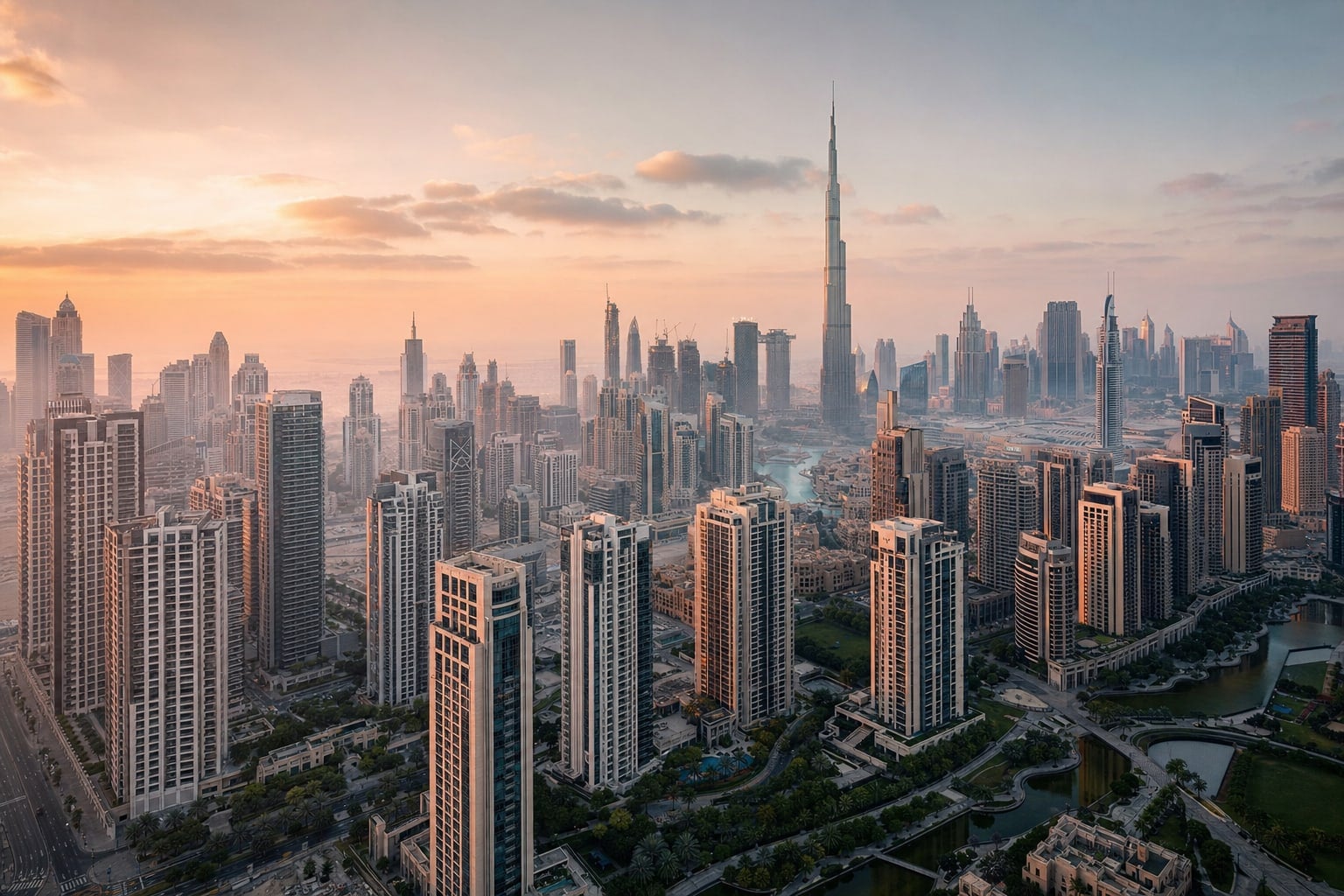
Key takeaways
- Investing in Dubai in 2026 remains a solid thesis for the disciplined investor — provided you filter by zone and asset type, and don't mistake a two-speed market for uniform overheating.
- The "bubble" narrative is contradicted by the numbers: over 226,000 transactions recorded by the DLD in 2024 (+36% year-on-year), a pace confirmed in Q1 2026 — a sign of market depth, not speculative fever.
- Gross yields reach 5–8% depending on the neighbourhood (REIDIN 2026), versus 2.5–3.5% in Paris or Geneva — with zero tax on rental income or capital gains in the UAE.
- The AED has been pegged to the USD since 1997 at 3.6725 AED/USD: for a long-term portfolio, this arrangement eliminates most structural currency risk.
- The real risk is not the Dubai market as a whole — it is the buyer who ignores sub-market granularity. Mature zones (Marina, Downtown) compress yields; well-selected emerging neighbourhoods preserve the equation.
- 2026 verdict: the entry point remains favourable for investors who apply selection discipline. This guide breaks down DLD, REIDIN and IMF data to move beyond the consensus.
Why does the "Dubai bubble" narrative miss the data?
The bubble thesis rests on a fundamental confusion: it aggregates radically different markets. Prime, mid-market and emerging off-plan do not share the same cycle, the same buyers or the same leverage. Collapsing them into a single diagnosis is like declaring an entire population has a fever because a few individuals hit 38°C.
Prices still far below major global capitals
Despite the 2022–2025 run-up, Dubai remains significantly cheaper per square metre than London, Paris, Geneva, Hong Kong or New York. REIDIN data shows average residential prices around EUR 1,500/m² in peripheral areas and between EUR 8,000 and EUR 15,000/m² on Palm Jumeirah or in Downtown — levels that, in real terms, remain below the 2014 peaks once adjusted for inflation.
Volumes that reflect genuine market depth
The Dubai Land Department recorded over 226,000 transactions in 2024, up roughly 36% year-on-year — a volume that reflects broad structural demand, not a concentrated speculative spike.
A bubble market is typically characterised by excessive bank leverage. Mortgage financing accounts for roughly 40% of transactions in Dubai; the remainder is cash. That ratio is the inverse of 2008: less systemic debt, less potential contagion in a downturn.
Segmentation is the key to an honest reading. An apartment in Jumeirah Village Circle at EUR 1,400/m² and a Palm penthouse at EUR 25,000/m² do not move in the same cycle. Conflating the two is precisely the mistake the dominant media narrative keeps making.
A two-speed market: where does the real 2026 opportunity lie?
Dubai is not monolithic. Beneath the aggregated average, three segments coexist with radically different risk and return profiles. Investors who treat the market as a single block miss the point entirely.
Established prime (Palm Jumeirah, Emirates Hills, Downtown) has absorbed most of the 2022–2025 appreciation. Gross yields there have compressed to 4–5%, and future capital gains will be more gradual. This is a capital-preservation play, not a yield engine.
Mid-market (JVC, Business Bay, Dubai Hills) presents a more compelling profile for 2026. Rental demand is structural: it is driven by Golden Visa holders, MENA expatriates and corporate relocations. Observed gross yields range between 6% and 8%, supported by sustained tenant turnover.
The off-plan signal investors underestimate
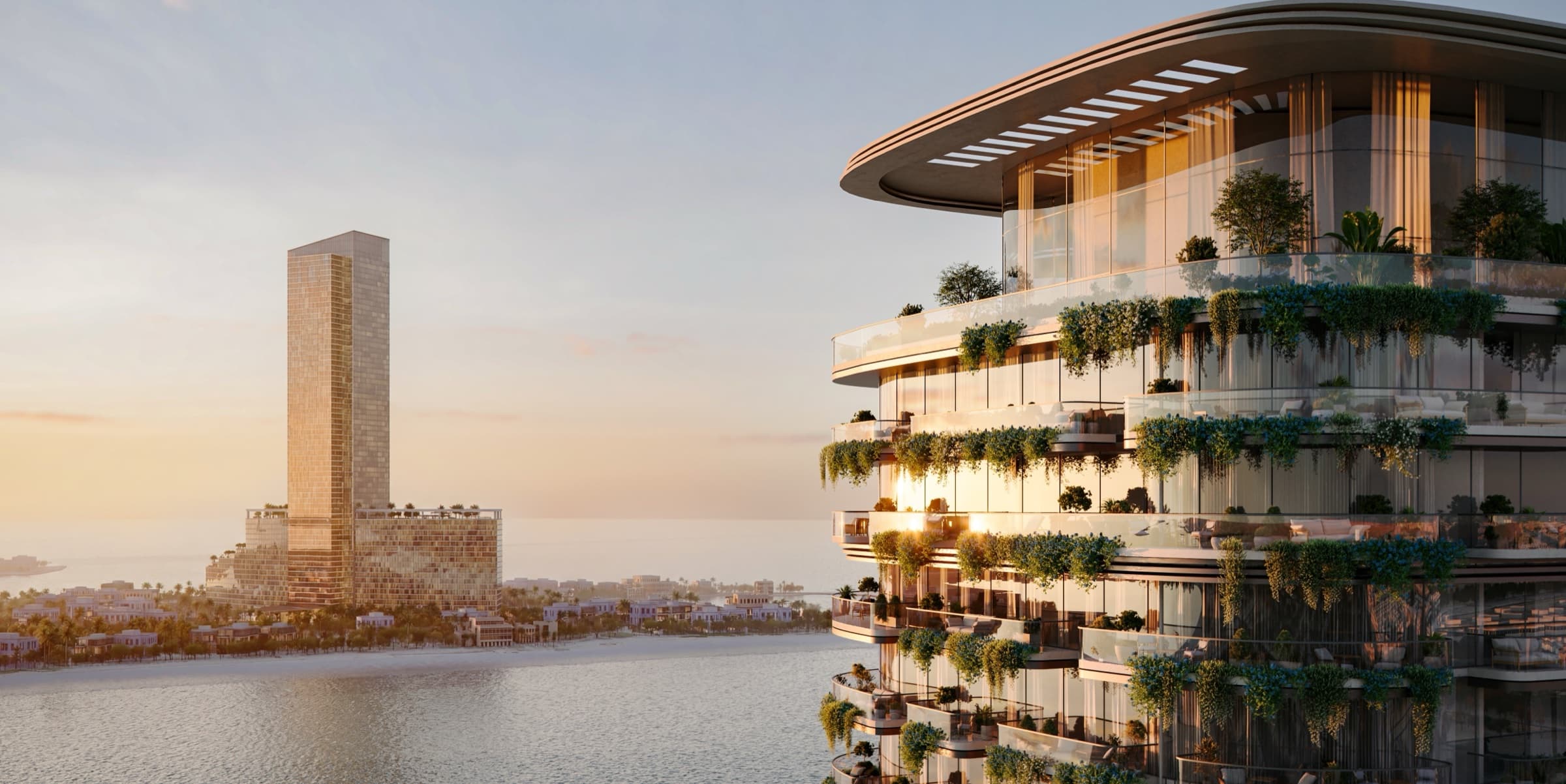
Emerging zones — Dubai South, Meydan, and above all Marjan Island in Ras Al Khaimah — combine entry prices well below prime levels with 60/40 payment plans that spread cash outlay through to delivery.
Wynn Resorts has confirmed the opening of Wynn Al Marjan Island in Ras Al Khaimah, scheduled for 2027 — the region's first integrated resort and a documented value catalyst for the northern Emirates.
The upside is tied to 2026–2028 deliveries: as infrastructure completes, secondary prices tend to converge toward those of neighbouring mature zones. This is precisely the kind of arbitrage — zone, timing, developer — that we structure for our clients through our projects and our partner developers. Our 2026 off-plan guide covers the full mechanics.
6–8%Gross yield, mid-market (JVC, Business Bay, Dubai Hills) · REIDIN 2026What does a Dubai property actually return?
A foreign investor comparing Dubai to Paris, Lyon or Brussels quickly spots a structural gap. Gross yields in Dubai range between 5% and 8% by neighbourhood in 2026, against 2.5% to 3.5% in major Continental European cities. That 300–400 basis point differential, before tax, is the primary reason this market deserves serious analysis.
From gross to net: what service charges actually change
Gross yield does not tell the whole story. Service charges, registered and capped by the Dubai Land Department, typically run between 15 and 25 AED per square foot per year. On an 800 sq ft apartment, that is roughly AED 12,000–20,000 annually — a drag of 0.5 to 1.2 percentage points on yield, depending on the purchase price. Build this into every model, without exception.
15–25 AED/sq ft/yearDLD service charges (average) · Dubai Land Department 2026Taxation: the decisive argument
The real difference emerges at the tax stage. In the UAE, rental income and capital gains remain taxed at 0% for individuals. An investor who becomes a UAE tax resident also benefits from the France-UAE tax treaty: property income is then taxed in Dubai, not France.
To stress-test a specific asset before making an offer, our net yield calculator lets you factor in service charges, vacancy and tax structure in minutes.
Risks that the data makes visible
Acknowledging the grey areas does not weaken the thesis — it makes it credible. Here are the four risks that 2026 data renders measurable.
Localised oversupply
Certain communities — JVC, peripheral Business Bay, Dubailand — face a projected delivery of 30–40% additional stock by 2027, according to pipeline-tracking data from the Dubai Land Department. Rental pressure will be real in these micro-markets. The answer: select zones where supply is constrained (Palm, Downtown, Dubai Marina), not communities overloaded with new launches.
Developer quality dispersion
Two adjacent projects can show an estimated valuation gap of ~20% based on developer brand alone. This is not an anomaly — it is a measurable reputation premium recorded at the DLD. Our distress deals by community framework illustrates exactly this gap.
~20%Valuation gap between developers (same zone) · DLD / REIDIN observations 2026Exit liquidity
In established prime, the exit window runs 30 to 90 days. In mid-market off-plan, it lengthens considerably. For precisely this scenario, a structured exit mechanism exists: Sell in 48h delivers a firm off-market offer, with no agency fee and no viewings.
Regional geopolitical risk
The risk exists — denying it would be dishonest. But the AED-USD peg, uninterrupted since 1997, acts as a structural monetary buffer. Historically, regional tension episodes have driven capital flows into Dubai, not out of it.
How does an international investor position in 2026?
Whether you are based in Paris, Brussels, Geneva, Montreal, Tel Aviv or New York, the mechanics of a Dubai property investment follow the same five steps. Geographic distance does not fundamentally complicate the process — it simply requires rigorous coordination at each decision point.
Step 1 — Define the objective first
Three logics coexist: immediate cash flow, capital gain on resale, or residency via the Golden Visa. The Golden Visa threshold requires a minimum purchase of AED 2M in a completed asset. Each objective points to a different zone and asset type. Pursuing more than one without a clear trade-off dilutes both.
Step 2 — Select 2–3 zones aligned with the thesis
Mid-market (JVC, Al Furjan, Dubai South) offers estimated gross yields of 7–8%. Emerging off-plan (Ras Al Khaimah, Dubai Islands) targets capital appreciation over income. Our off-plan investor guide details selection criteria zone by zone.
Step 3 — Structure the purchase around your tax residency
UAE tax residents pay 0% tax on rental income and capital gains. For non-resident French nationals, the DGFiP taxes foreign-source income; for US citizens, the IRS applies its standard worldwide income rules.
The purchase structure — individual, local LLC or holding company — must be decided before signing, not after. This is the most underestimated step for investors buying without advisory support.
Steps 4 and 5 — Coordinate, deliver, manage
Notary coordination, local banking and handover represent the most time-intensive phase. Our services cover these steps end to end — from DLD due diligence through to post-handover rental management.
7–8%Dubai mid-market gross yield 2026 · REIDIN 2026After handover, tracking real net yield (service charges, vacancy, management fees) is the only metric that matters. Use the net yield calculator to model your scenario before committing.
Contrarian verdict: Dubai remains the best arbitrage of 2026
The data leaves little room for debate. In Paris, gross yields stagnate between 2.5% and 3.5%, and every rent collected bears the IFI wealth tax, property income tax and social levies. In Dubai, 5–8% gross becomes 5–8% net — rental taxation is literally zero.
The AED has been pegged to the US dollar at 3.6725 AED/USD since 1997, confirmed by the UAE Central Bank. For an investor holding a portfolio in euros, Swiss francs or Canadian dollars, this fixed parity eliminates direct AED/USD currency risk — an advantage Paris, London or Geneva simply cannot replicate.
226,000+DLD transactions 2024 · Dubai Land Department 2024The catalyst pipeline is documented and dated: Wynn Al Marjan Island in 2027, Expo City, the Dubai 2040 Urban Master Plan. These are not promises — they are contractual commitments backed by billions of dollars already deployed.
The only bad trade in 2026: buying without filtering. Overbuilt zones, undercapitalised developers, asset types poorly matched to the rental market — selection discipline is everything. That is precisely the arbitrage framework we build for our clients through our advisory services.
For the disciplined francophone or international investor, Dubai offers the best yield / taxation / liquidity ratio of any prime market globally in 2026. No European equivalent aligns all three parameters simultaneously.
Go further
Three complementary reads in the Level8 journal:
- Distress Deals in Dubai: real discount or marketing in 2026? — How to verify a genuine discount on a Dubai distress deal: DLD pricing, motivated-seller signals and a due-diligence checklist.
- Dubai Real Estate Crash: myth or reality in 2026? — The 2008 and 2014 crashes, 2026 leading indicators, developer debt and RERA liquidity: a data-driven reading of a cycle unlike any previous one.
- Off-plan in Dubai in 2026: the investor's guide — Payment plans, reliable developers, 6–8% yields and the RERA framework. A guide for investing confidently from abroad.
FAQ
What gross rental yields can you realistically expect in Dubai in 2026?
REIDIN 2026 data shows gross yields between 5% and 8% depending on the neighbourhood. Mid-market areas (JVC, Business Bay, Dubai Hills) sit at the top of that range, at 6–8%, versus 4–5% for established prime (Palm Jumeirah, Downtown). For comparison, Paris and Geneva deliver 2.5–3.5% gross — without the UAE tax advantage.
How does UAE taxation apply to rental income earned by a French investor?
The UAE levies no tax on rental income or property capital gains for non-residents. France and the UAE have signed a tax treaty: UAE-source income is not subject to French income tax, though it may be taken into account when calculating the effective rate. A Franco-UAE tax adviser is recommended to structure ownership correctly — particularly via an SCI or holding company.
What is the minimum investment to qualify for the Dubai Golden Visa?
A real estate purchase of at least AED 2M (approximately EUR 500,000 at the fixed rate of 3.6725 AED/USD) qualifies for the 10-year renewable Golden Visa. The property can be acquired in full ownership, cash or mortgage, within freehold zones open to foreign nationals. The visa also covers the investor's spouse and dependent children.
What are the concrete risks of buying off-plan in Dubai in 2026?
The main risk is developer delay or default. RERA regulations require that 100% of buyer funds be held in an escrow account controlled by the DLD, released in tranches tied to actual construction progress. Choosing a first-tier developer (rated and listed by the DLD) significantly reduces this risk. Liquidity risk also exists: reselling before delivery depends on the depth of the secondary off-plan market, which is higher on flagship projects.
How does the AED/USD peg protect a European investor against currency risk?
The AED has been fixed to the US dollar since 1997 at 3.6725 AED/USD, by decision of the UAE Central Bank. This peg eliminates AED/USD volatility but leaves the European investor exposed to the EUR/USD cross rate. Over a long investment horizon, that risk is manageable and substantially lower than the currency exposure of an investment in a floating emerging-market currency.
What is the difference between a ready property and an off-plan property for an investor in 2026?
A ready property generates rental income immediately and offers clear visibility on real yield; its price already includes the delivery premium. An off-plan property lets you enter at a lower price with a staggered payment plan (often 60/40 through to delivery), but defers cash flow by 12 to 36 months depending on the project. In 2026, emerging zones such as Dubai South and Marjan Island offer the most significant off-plan entry discounts, backed by a documented value catalyst: Wynn Al Marjan Island, scheduled to open in 2027.