Key takeaways
- Emaar Properties is Dubai's leading listed developer in 2026: AED 35.1B in consolidated 2025 revenue, with a net margin of roughly 37%.
- Investment Corporation of Dubai holds 24.9% of the capital. The free float stays with the market, imposing a governance discipline rarely seen in the region.
- Over 100,000 units delivered since 2002, spread across six major communities: Downtown, Dubai Marina, Emaar Beachfront, Dubai Hills Estate, Arabian Ranches, Dubai Creek Harbour.
- Gross yields observed in Q1 2026: 5.8% in Downtown, 6.0% in Emaar Beachfront, 6.4% in Dubai Hills Estate, 7.1% in Dubai Creek Harbour (REIDIN).
- Local tax stands at 0% on rental income and capital gains. Net Emaar yields typically fall between 4.8% and 5.5% after service charges and property management.
- The pre-delivery sales backlog reached AED 111B at the end of 2025 — roughly three years of revenue already secured. That's a solidity signal rarely available among competing developers.
Who is Emaar, and what does the group represent in 2026?
Emaar Properties is a listed developer, founded in 1997 by Mohamed Alabbar. It listed on the Dubai Financial Market in 2000, and has been subject to public-shareholder discipline for 25 years since. Investment Corporation of Dubai holds 24.9% of the capital; the remainder is split between institutional and retail shareholders, largely international.
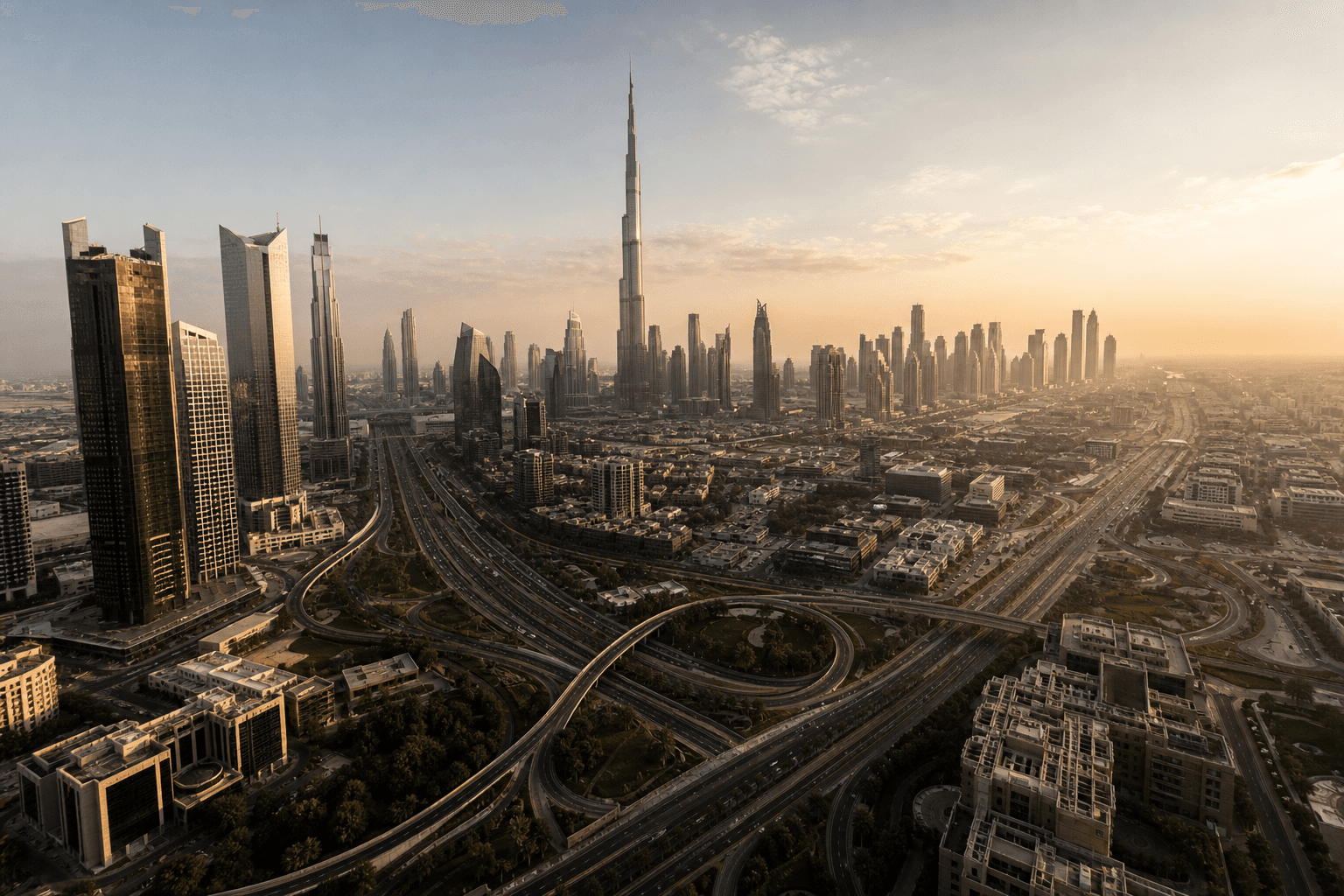
The group built Dubai's center of gravity: Burj Khalifa, Downtown Dubai, and Dubai Mall remain its most-cited achievements. This urban footprint explains why the Emaar brand still serves as a benchmark for the secondary market. A property "next to an Emaar project" is valued differently on DLD.
Emaar Development's pre-delivery sales backlog reached AED 111 billion at the end of 2025, roughly three years of revenue already secured.
This backlog gives the group rare visibility for an off-plan developer: future deliveries are already sold and being paid off in installments.
Three subsidiaries, three value engines
The group's structure breaks down into three complementary blocks:
- Emaar Development — the residential engine, source of the AED 111B backlog
- Emaar Malls — Dubai Mall and commercial real estate, recurring rental income
- Emaar Hospitality — hotels and management, including the Address Hotels + Resorts brand
This diversification limits reliance on off-plan sales alone, unlike single-product developers. It also explains why Emaar is often cited as the benchmark for branded launches, like those detailed in our analysis of branded residences in Dubai.
Which Emaar communities, and what yields, in 2026?
Emaar Properties currently manages six major communities in Dubai, each with a very different profile. Downtown Dubai leads on liquidity, Dubai Creek Harbour on yield, Emaar Beachfront on waterfront positioning. The right choice mostly depends on your objective: cashflow, capital gain, or fast resale.
Downtown Dubai remains the group's showcase. The average price reaches ~AED 28,000/m²Downtown Dubai Price Q1 2026 · DLD, Q1 2026, up 9% year-on-year. The gross yield here is the lowest in the portfolio, at 5.8%, offset by maximum resale liquidity: it's the easiest address to exit if you need cash.
Dubai Hills Estate targets structural family demand, driven by schools, a hospital, and golf. Average price around AED 19,000/m², gross yield of 6.4%.
Dubai Creek Harbour offers the best price-to-yield ratio in the portfolio.
Dubai Creek Harbour posts an average gross yield of 7.1% in Q1 2026, ahead of Dubai Hills (6.4%) and Downtown (5.8%).
Estimated average price of AED 22,000/m², with dense deliveries planned for 2026-2027 — a point worth monitoring.
Emaar Beachfront positions itself as premium waterfront, around AED 32,000/m², gross yield of 6.0%. The Valley and Arabian Ranches III offer villas between AED 2.5M and 4.5M. The logic here is capital gain, not immediate cashflow.
| Community | Price/m² (AED) | Gross Yield | Investor Profile | Point to Watch |
|---|---|---|---|---|
| Downtown Dubai | ~28,000 | 5.8% | Liquidity, prestige | Already high price |
| Dubai Hills Estate | ~19,000 | 6.4% | Family, long-term rental | Competition from secondary supply |
| Dubai Creek Harbour | ~22,000 | 7.1% | Rental yield | Dense deliveries 2026-2027 |
| Emaar Beachfront | ~32,000 | 6.0% | Premium waterfront | High entry ticket |
| The Valley / Arabian Ranches III | villas AED 2.5-4.5M | variable | Capital gain, family use | Longer exit horizon |
Where the simultaneous-supply risk sits
Dubai Creek Harbour concentrates the largest volume of Emaar deliveries over 2026-2027. A wave of units arriving at once can temporarily weigh on rents, before the rental market fully absorbs them. This is exactly the kind of delivery-timing arbitrage we work through with our clients before booking, notably through our current projects under direct sale. Downtown, by contrast, suffers less from this risk: available land there is nearly exhausted.
How does Emaar compare to Dubai's other developers?
In Dubai's market, Emaar holds a singular position: the most liquid developer, not necessarily the cheapest or the most upscale. Against DAMAC, Sobha, Nakheel, and OMNIYAT/BEYOND, the comparison plays out on three axes: entry ticket, resale liquidity, and segment positioning.
Emaar dominates on DLD transaction volume. A property resold in Downtown or Dubai Creek Harbour finds a buyer within weeks, versus several months for more niche communities. This liquidity gap, more than price per square meter, justifies the Emaar premium.
DAMAC plays a different card: lower entry ticket, aggressive marketing, sustained launch pace. The trade-off is more variable delivery quality, documented through finishing discrepancies across phases.
Sobha bets on in-house quality control — manufacturing and installing finishes within the group — but its communities remain smaller, with lower secondary liquidity.
Nakheel retains a structural advantage: land control over Palm Jumeirah, a location no one can replicate. Its post-merger pipeline with Dubai Holding is, however, less transparent for the external investor.
OMNIYAT and BEYOND don't really compete with Emaar: above AED 5 million, it's a separate ultra-luxury waterfront segment, as illustrated by branded residences commanding a 56% premium over non-branded stock.
| Developer | Entry Ticket | Resale Liquidity | Dominant Segment |
|---|---|---|---|
| Emaar | Mid-high | Very high | Integrated communities, Downtown/Creek |
| DAMAC | Low-mid | Medium | Volume, accessible pricing |
| Sobha | Mid-high | Low-medium | Finishes, build quality |
| Nakheel | High | Medium-high | Unique land, Palm |
| OMNIYAT/BEYOND | Very high (>AED 5M) | Low (niche) | Ultra-luxury waterfront |
For an investor prioritizing fast exit and Golden Visa eligibility via an AED 2 million ticket, Emaar remains the market's most rational choice.
From gross to net yield: what's actually left
A gross yield of 5.8% in Downtown or 7.1% in Dubai Creek Harbour doesn't automatically translate into net cashflow. Two cost lines reduce this figure: service charges and property management.
Emaar service charges range from AED 15 to 22/sqft/year, depending on the project and amenity level (pool, concierge, security, green spaces). On a 90 m² two-bedroom (≈ 970 sqft), that's between AED 14,550 and 21,340 per year — roughly EUR 4,000 to 5,800. If you outsource rental management to a third party, expect around 5% of collected rent on top.
Once both costs are deducted, the net yield across the delivered Emaar portfolio sits between 4.8% and 5.5%, versus 5.8% to 7.1% gross.
4.8% to 5.5%Net Yield, Delivered Emaar Portfolio · Level8, estimate based on REIDIN Q1 2026 dataThis gross-to-net gap remains favorable compared to most mature markets. Local taxation doesn't cut into it any further: 0% tax on rental income and capital gains for individuals in the UAE, regardless of nationality.
What about buyers from France, Belgium, Switzerland, or Canada?
The absence of local taxation doesn't remove the need for planning in your country of residence. For a French, Belgian, Swiss, or Canadian tax resident, taxation of rental income and capital gains depends on domestic law and the applicable tax treaty with the UAE. This needs to be framed before the purchase, not after the first tax return.
This is exactly the kind of arbitrage we work through for our clients, notably to compare a delivered Emaar asset against an off-plan opportunity figure by figure. The Level8 net-yield calculator lets you simulate both scenarios under the same cost and tax assumptions.
How do you buy an Emaar property from abroad?
Remote purchase of an Emaar property follows a standardized sequence, managed largely through the DLD escrow account. No physical presence is required, from booking through to renting out the unit.
1. Booking and payment plan. An initial deposit of 10 to 20% secures the unit. The most common plans remain 80/20 (80% during construction, balance on handover) and 60/40 with post-handover, where the balance is spread out after key handover.
2. SPA signature and escrow transfer. The Sale and Purchase Agreement can be signed remotely. Funds flow into the DLD escrow account dedicated to the project — a regulatory protection that secures the buyer in case of developer default.
3. Oqood, then title deed. The unit is registered under Oqood as soon as it's sold off-plan, then converted into a definitive title deed on handover. Dubai Land Department fees of 4% apply to the property value, on top of transfer fees.
4. Power of attorney and bank account. If travel to Dubai isn't possible, a notarized power of attorney (POA) lets a representative sign locally. A UAE bank account isn't mandatory, but it simplifies transfers and future rental management.
AED 2M10-Year Golden Visa Threshold · u.aeAn Emaar property above this threshold qualifies for the 10-year Golden Visa, renewable, with no employer sponsor required. It's a frequent draw for French, Belgian, or Canadian buyers seeking a second home paired with long-term residency status.
Last step: setting up rental management, then declaring income in your country of tax residence. Dubai taxes neither rents nor capital gains, but the reporting obligation still applies in France, Belgium, or Canada, per the tax treaties in force.
What to check before signing
- Escrow account status and percentage of construction already funded
- Consistency between the advertised payment plan and the contractual delivery schedule
- Additional costs: DLD 4%, registration fees, post-handover service charges
- Penalty clause in case of delivery delay
This is exactly the kind of setup we work through for our clients, from project selection through the net-yield calculator to France-UAE tax structuring.
Verdict: what place should Emaar hold in a portfolio
Emaar remains, in 2026, the reference asset for a first purchase in Dubai. The developer combines resale liquidity, buyer-pool depth, and transaction transparency via the Dubai Land Department. For an investor new to the market, it's the choice that minimizes execution risk — not necessarily the one that maximizes yield.
Allocation depends on the profile.
Cashflow profile: Dubai Creek Harbour and Dubai Hills dominate on gross yield, with a clear gap versus mature neighborhoods.
Gross Yield by Emaar Community (Q1 2026)
| Metric | Value (%) |
|---|---|
| Dubai Creek Harbour | 7.1 % |
| Dubai Hills | 6.4 % |
| Downtown | 5.8 % |
Source: REIDIN, Q1 2026
Wealth-preservation profile: Downtown and Emaar Beachfront remain the bets on resale value and land scarcity, even at the cost of 1 to 1.5 points of rental yield.
Against Paris, Brussels, or Geneva, the net yield gap remains structural. The absence of local tax on rents and capital gains mechanically amplifies Dubai's advantage, whichever sub-market you choose.
5.8%Downtown Gross Yield · REIDIN, Q1 2026The real arbitrage, then, isn't about the Emaar brand itself. It's about the specific project and its delivery date. This is the kind of project-by-project selection we work through for our clients, weighing available projects against their payment schedules.
A ticket starting at AED 2 million also qualifies for the 10-year Golden Visa — one more reason to structure the purchase rather than just go along with it.
Go further
Three related reads from the Level8 journal:
- Bugatti Residences Dubai: the real investment case in 2026 — Bugatti Residences Dubai broken down for investors: price per m², payment plan, rental yield, and comparison against Armani, Cavalli, and Mercedes-Benz Places.
- Al Reem Island: 49% of Abu Dhabi's off-plan sales this summer — Yes, Al Reem Island dominates Abu Dhabi's off-plan market: 1,291 of the 2,658 off-plan apartment sales in summer 2026, or 49%. Sold floor area has quadrupled in two years, per MERED.
- Dubai Jumeirah Park: how to buy a villa in 2026 — A step-by-step guide to buying a villa in Dubai Jumeirah Park in 2026: DLD process, escrow, added costs, 3-4BR yields, and off-plan vs resale arbitrage.
FAQ
What's the average gross yield on Emaar properties in 2026?
Gross yields observed in Q1 2026 range from 5.8% in Downtown Dubai to 7.1% in Dubai Creek Harbour, per REIDIN. After service charges and property management fees, net Emaar yields typically fall between 4.8% and 5.5%.
How does taxation work on an Emaar investment from France, Belgium, or Canada?
The UAE applies no taxation on rental income or property capital gains. A French resident remains subject to the France-UAE tax treaty when declaring rental income, but no local tax is levied in Dubai.
Which Emaar community should you choose for optimal rental yield?
Dubai Creek Harbour offers the portfolio's best price-to-yield ratio, at 7.1% gross yield in Q1 2026, ahead of Dubai Hills Estate (6.4%) and Emaar Beachfront (6.0%). Downtown Dubai yields less (5.8%) but compensates with maximum resale liquidity.
What's the risk from dense deliveries in Dubai Creek Harbour in 2026-2027?
A wave of units arriving at once can temporarily weigh on rents, before the rental market fully absorbs them. It's a point to factor into your buying timeline, particularly for an investor seeking immediate cashflow rather than capital gain.
Is Emaar's AED 111B backlog a guarantee of solidity for an off-plan buyer?
Yes: this backlog represents roughly three years of revenue already secured through pre-delivery sales, a solidity signal rarely available among competing developers. This visibility limits the risk of delay or project cancellation compared to single-product developers without an equivalent financial reserve.
Can you get the Golden Visa by buying an Emaar property?
Acquiring a property in Dubai worth a minimum of AED 2 million, including from Emaar, qualifies you for the 10-year Golden Visa. Downtown, Dubai Hills Estate, or Emaar Beachfront projects generally exceed this threshold, depending on the unit type chosen.
Sources
The figures and rules quoted in this article come from the following sources :