Key takeaways
- The 2026 Dubai developer ranking (fäm Properties, 23 July 2026) records 36,808 residential transactions and AED 86.8B in cumulative sales for the top 10, from January through late July 2026.
- Emaar dominates by value: AED 30.6B in sales, +83% ahead of DAMAC (2nd) — driven by 150 projects under construction, the deepest pipeline in the market.
- Azizi leads by volume: 8,411 residential sales, concentrated below AED 2M — the core of the accessible rental segment.
- The ultra-luxury segment (> AED 15M) recorded 1,248 transactions totalling AED 35.16B — record liquidity at the top of the market.
- Both ends of the market (entry-level rental and ultra-luxury) are growing simultaneously. This signals structural demand, not speculation — and strengthens the long-term investment case.
What does the fäm Properties report of 23 July 2026 say?
Published on 23 July 2026, the fäm Properties report aggregates all transactions registered with the Dubai Land Department between 1 January and 22 July 2026. It covers the ten most active residential developers over that period — a precise, auditable, and directly citable dataset.
Two distinct logics emerge from the data.
By value, Emaar Properties stands alone: AED 30.6B in sales, a gap of +83% over DAMAC, its closest rival. That ratio reflects a deliberate focus on high-ticket assets — Downtown, Creek Harbour, Emaar Beachfront.
By volume, Azizi Developments leads with 8,411 units sold, mostly below the AED 2M threshold (≈ EUR 500,000). That median ticket matches exactly what investors from France, Belgium, or Canada seek as an accessible entry point.
36,808Units sold — Top 10 developers (Jan.–22 Jul. 2026) · fäm Properties, 23 Jul. 2026Binghatti, Sobha, and Omniyat round out the ranking, each in a distinct segment: Binghatti in dense mid-market, Sobha in premium peri-central residential, Omniyat in signature ultra-luxury. This segmentation matters — it directly shapes the strategy for any investor entering the market in 2026.
Why does Emaar dominate by value?
Emaar is not simply the top-ranked developer — it is a category of its own. With AED 30.6B over the first seven months of 2026, it sits +83% above DAMAC in second place. That gap is not explained by transaction volume. It is explained by the pricing mechanics of its assets.
Emaar has 150 residential projects under construction in Dubai in 2026 — the deepest pipeline in the market. This scale ensures a permanent presence across the city's most sought-after zones.
Premium positioning as the core driver
Emaar concentrates its launches across four high-unit-value clusters: Downtown Dubai, Dubai Hills Estate, Creek Harbour, and Emaar Beachfront. These addresses carry some of the highest price-per-square-foot figures outside Palm Jumeirah. The product mix — villas at Dubai Hills, Creek-view apartments, waterfront units — mechanically pushes the average ticket upward.
2027–2029 deliveries reinforce this logic. Buyers today pay an anticipation premium on assets whose scarcity is contractually locked in by each zone's masterplan.
35%Emaar's share of top-10 AED 86.8B total · fäm Properties, July 2026A resale liquidity premium
For international investors, the Emaar brand has a concrete effect at resale. In a zone like Creek Harbour, an Emaar property trades at an observable liquidity premium. The next buyer accepts a compressed yield in exchange for delivery certainty. Our guide Creek Dubai: the 4 sub-zones in 2026 quantifies that gap zone by zone.
Azizi and the sub-AED 2M segment: the real rental engine
8,411 residential sales in 2026 — Azizi Developments' volume figure, concentrated on tickets between AED 800,000 and AED 2,000,000. It exceeds every other developer in absolute transaction count. It also reveals a segment that observers frequently underestimate: genuine end-user demand, the kind that sustains a healthy rental market.
A structurally rental-driven buyer profile
The typical buyer in this segment is a young resident professional, a first-time investor from Paris, Brussels, or Montreal, or an expat looking for a first Dubai home. This is not a trophy buyer — it is an end user. That distinction matters. Where luxury units are often flipped before handover, Azizi's segment generates actual occupancy.
6–8%Gross rental yield — AED 800K–2M segment (Meydan, Al Furjan, MBR City) · Knight Frank / REIDIN 2026Azizi Riviera and Venice: the 2026–2027 rental effect
The phased deliveries of Azizi Riviera and Azizi Venice between 2026 and 2027 convert that volume into near-immediate income. Delivered units enter a tight rental market directly — low vacancy, demand sustained by a steady influx of new residents. For an investor targeting a gross yield of 6–8% at an accessible ticket, this segment is the most liquid entry point in Dubai in 2026.
Our net yield calculator lets you model these cash flows on an Azizi apartment in minutes.
Ultra-luxury: AED 35.16B in 7 months — a strong signal
Ultra-luxury is no longer a niche in Dubai. In barely seven months, the segment has generated a volume that exceeds the full-year residential markets of several European capitals.
≈ AED 28.2MAverage value per ultra-luxury transaction · fäm Properties / DLD, July 20261,248 properties above AED 15M sold for AED 35.16B between January and July 2026 — roughly 6 transactions per day.
Palm Jumeirah, Emirates Hills, Jumeirah Bay, and District One account for the bulk of these sales. Supply in these locations is structurally constrained — available land is nearly exhausted — which anchors valuations over the long term.
The buyer profile is telling. Most purchasers are European, Israeli, and American HNW individuals. Cash accounts for more than 70% of transactions in this segment, with no dependency on credit or rate cycles.
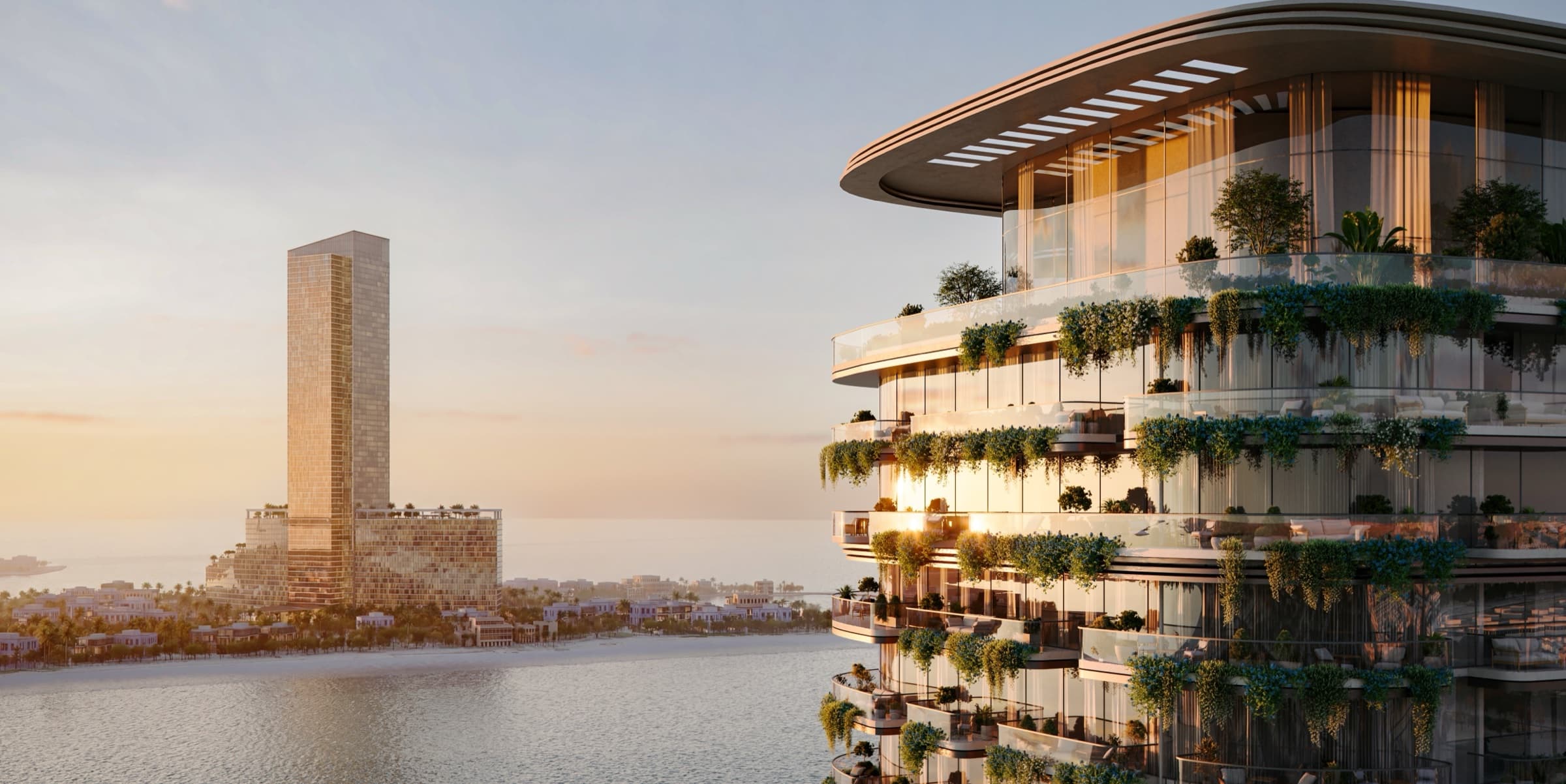
In this space, Omniyat — a Level8 partner through the BEYOND programme — delivers signature projects that set the benchmark for design and pricing. These are precisely the assets an HNW investor seeks: controlled scarcity, architectural brand value, and resale liquidity backed by international demand.
What this ranking means for international investors
The dual market revealed by this top 10 is not a statistical abstraction. It translates into three distinct investment strategies by ticket size — and an off-plan window that is closing progressively ahead of 2027–2029 deliveries.
Ticket below EUR 500,000: cash flow first
Azizi and Binghatti dominate this segment. Their units are priced mainly below AED 2M, with observed gross yields of 7–9% depending on location. The goal here is immediate cash flow from handover — not a ten-year capital gain story.
8,411 transactionsAzizi 2026 sales (volume) · fäm Properties, July 2026Ticket EUR 1–3M: resale play (Emaar) or premium finish (Sobha)
At this level, the choice is strategic. Emaar offers the strongest resale liquidity — its brand is recognised from Montreal to Tel Aviv. Sobha targets investors who prioritise finish quality and can wait longer for capital appreciation to crystallise. Both approaches are valid; the deciding factor is your exit horizon.
Ticket above EUR 4M: liquid ultra-luxury
1,248 properties above AED 15M found buyers between January and July 2026, totalling AED 35.16B. Omniyat and Emaar Beachfront concentrate this demand. Resale liquidity is established — and the off-plan window, still open at developer pricing, remains the primary lever.
The market's duality mechanically reduces the risk of a sharp sectoral correction: both ends of the spectrum are moving simultaneously. This is precisely the type of arbitrage we frame for our clients at Level8, through our projects or structured advisory via our services.
Verdict: a mature market, not a bubble
AED 86.8B generated by ten developers in seven months: this figure does not point to speculative overheating. It reflects structural demand, driven by two distinct engines — the sub-AED 2M entry segment and ultra-luxury above AED 15M — that coexist without cannibalising each other.
The macro thesis remains intact: zero tax on rental income and capital gains, a dirham pegged to the US dollar, and a delivery pipeline running through 2026–2028 that provides clear forward visibility. These fundamentals are verifiable on the Dubai Land Department website and depend on no local political cycle.
AED 86.8BTop-10 developer transactions (Jan.–Jul. 2026) · fäm Properties, Jul. 2026The right move in 2026 is not choosing between Dubai and somewhere else. It is choosing the developer that matches your entry ticket and exit horizon: Emaar for safe-haven value and secondary-market liquidity, Azizi for volume and fast rental yield, OMNIYAT/BEYOND for ultra-premium positioning.
This is exactly the type of arbitrage we structure directly with our referenced developers — explore our projects or our services for a personalised framework.
Further reading
Three complementary reads from the Level8 journal:
- Damac Hills 2: the investor guide 2026 — Data-driven analysis of Damac Hills 2 in 2026: prices, yields, off-plan deliveries, tenant profile, and liquidity compared to Damac Hills 1.
- Disneyland Abu Dhabi: what impact on property investment? — A quantified analysis of the Disneyland Abu Dhabi effect on Yas Island and Dubai: expected valuations, timeline, and investment angles for 2026.
- Marsa Al Saadiyat: Aldar launches AED 100B on Saadiyat — Marsa Al Saadiyat: Aldar unveils a AED 100B masterplan spanning 6.4M m² and 8 km of waterfront. Off-plan sales H2 2026.
FAQ
Which developer offers the best rental yield in Dubai in 2026?
The Azizi segment (tickets AED 800,000–2,000,000) delivers gross yields of 6–8% in zones such as Meydan, Al Furjan, and MBR City, according to Knight Frank/REIDIN 2026. Emaar projects in Downtown or Creek Harbour compress yield further (4–5% gross) but carry a resale liquidity premium. The choice depends on your objective: immediate cash flow vs. medium-term capital gain.
How can an investor buy off-plan in Dubai remotely?
The Dubai Land Department requires every off-plan transaction to be registered in the Oqood (DLD register of under-construction contracts), which legally secures the purchase from abroad. Deposit funds are held in a regulated escrow account, separate from the developer's account — RERA supervises this mechanism. From France, Belgium, Canada, or the US, the transaction can be signed via notarised power of attorney and SWIFT transfer, with no physical presence required.
What is the minimum investment to obtain a Golden Visa through Dubai real estate?
The real estate Golden Visa requires a minimum investment of AED 2,000,000 (≈ EUR 500,000) in a completed or off-plan property, registered with the DLD in the buyer's name. This threshold sits precisely at the top of the Azizi range (AED 800,000–2,000,000), making this ticket relevant for investors targeting both rental yield and residency. The visa is renewable and covers a spouse and dependent children.
What tax applies to rental income for a French resident who owns property in Dubai?
The UAE levies no tax on rental income or real estate capital gains. However, a French tax resident must still declare this income in France: it is subject to income tax (progressive scale) and social contributions (17.2%), as the 1989 France-UAE tax treaty does not provide full exemption for foreign property income. Structuring through a holding company or changing tax residency materially alters this equation — a point to address with a specialist adviser before signing.
How do developer payment plans from Emaar or Azizi work in 2026?
Both developers offer staged payment plans, typically structured as 20% on reservation, quarterly instalments tied to construction progress, and 30–40% on handover. Azizi also offers post-handover payment plans, allowing buyers to defer up to 40% of the price over 2–3 years after key collection. These plans are recorded in the SPA contract registered with the DLD, and intermediate funds are held in RERA-regulated escrow.
Why does the ultra-luxury segment (above AED 15M) account for AED 35B in transactions in 2026?
The fäm Properties report of 23 July 2026 records 1,248 transactions above AED 15M totalling AED 35.16B — roughly 40% of the total top-10 value concentrated in fewer than 4% of units. This reflects an influx of international capital (Europe, Middle East, Asia) into tangible assets in a zero-tax jurisdiction, combined with a structurally limited ultra-luxury supply (Omniyat, BEYOND, Six Senses Residences). Liquidity at this level is real: observed resale timelines on the Palm and the central waterfront remain below 60 days for properties between AED 15M and AED 30M.