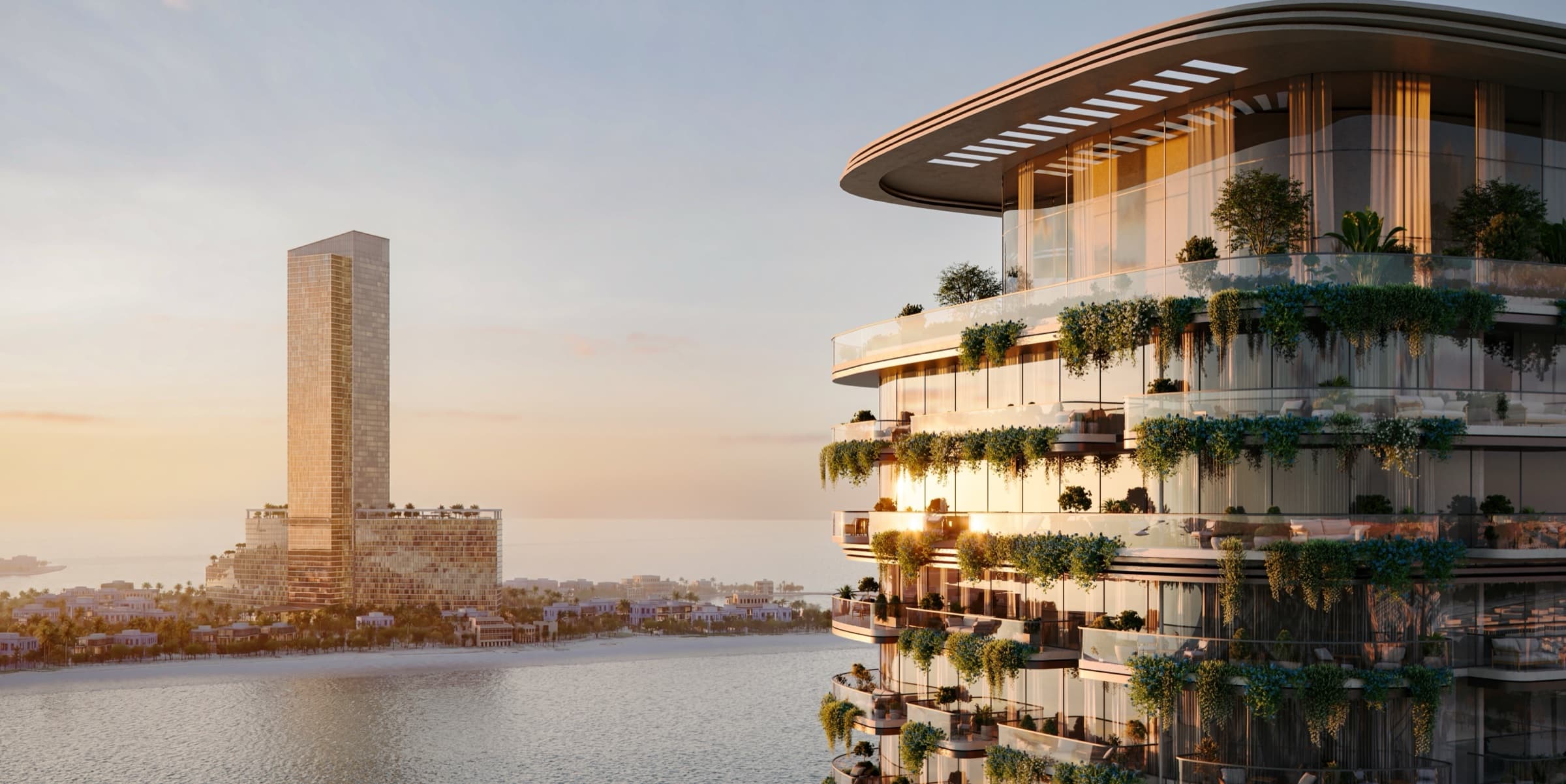

Why finance a Dubai property purchase rather than pay cash
Financing a Dubai property purchase from France, Belgium or Switzerland is rarely the default reflex among French-speaking investors. Most pay cash, instinctively. It is a capital allocation mistake: tying up 100% of equity in a single asset means giving up leverage, in a market that offers the right conditions to use it.
Gross yield as the starting point
Gross yields in Dubai's liquid markets — Dubai Marina, Business Bay, and Jumeirah Village Circle — range between 5% and 8%. The exact figure depends on transaction vintage and asset type. The article Marina vs Palm — the yield gap is closing covers the compression at play in premium segments. For a leveraged investor, this gross yield is the benchmark against the cost of debt.
5–8%Observed gross yield · Marina / Business Bay / JVC · REIDIN / DLD 2024-2025The cost of UAE credit for non-residents in 2025
UAE banks offer mortgage rates to non-residents estimated at 5.5% to 7.5% in 2025. Rates vary by profile, property, and lender. The spread between gross yield and cost of debt stays narrow, in the range of 0 to 200 basis points before tax. This is where the decisive variable comes in.
The 1989 France-UAE tax treaty assigns property income taxation to the UAE, where the rate is 0%. Net rental income is therefore not taxed again in France under the foncier regime.
This tax treatment changes the calculation. A gross yield of 6% against a mortgage rate of 6.5% may look tight on paper. But 0% tax on rental income and 0% on capital gains on the UAE side mechanically amplifies the net return on deployed equity. The post-tax spread is structurally more favourable in Dubai than on an equivalent asset in Paris, Brussels, or Geneva.
Freeing up European capital to diversify
Financing a Dubai property purchase at 50–60% LTV is the ceiling accessible to non-residents. It means retaining 40 to 50% of the asset price in liquid capital. That capital can stay invested in equities, EUR funds, or additional off-plan lots. The logic is not to borrow for its own sake. It is to avoid sacrificing portfolio diversification for a single real estate position.
The dirham has been pegged to the US dollar at AED 3.6725/USD since 1997: debt service in AED carries zero AED/USD currency risk, which simplifies cash-flow modelling over the full term of the loan.
For French, Belgian, and Swiss investors with EUR-denominated income, the only residual currency risk is EUR/USD. Most diversified portfolios already carry this exposure. It is a known, manageable constraint, and nothing like exposure to a free-floating emerging-market currency.
UAE mortgage for non-residents: the backbone of a Dubai property purchase
Contrary to a common misconception, UAE banks do lend to European buyers without requiring UAE residency. The non-resident segment of the Dubai market is served by several major institutions. Conditions are codified by the central bank, and processes for foreign applicants are well established.
The Central Bank of the UAE caps LTV at 75% for residents, but non-residents are generally limited to 50–60% of the property value depending on the lender and the borrower's profile.
In practice, five banks actively process non-resident applications from French-speaking investors: Mashreq, Emirates NBD, HSBC UAE, Standard Chartered, and ADCB. Mashreq and HSBC UAE have dedicated desks for international investors. They accept income denominated in euros or Swiss francs. In-principle approval timelines range from two to six weeks, depending on file completeness.
Loan terms typically run from 15 to 25 years. An age constraint applies: the borrower must not exceed 65 to 70 years of age at loan maturity. A 50-year-old investor can therefore borrow for 15 years at most lenders.
On rate structure, the UAE market operates in two phases. A fixed period of 3 to 5 years comes first, followed by a variable rate indexed to EIBOR (Emirates Interbank Offered Rate). In 2025, rates on non-resident offers range from 5.5% to 7.5%. They depend on the length of the fixed period, the LTV selected, and the income profile. The dirham's peg to the dollar since 1997 eliminates AED/USD currency risk on debt service. This simplifies modelling for investors who think in dollars or euros.
On top of the cost of credit, mandatory acquisition costs apply to any Dubai property purchase: 4% DLD fees payable by the buyer, plus bank processing fees of 0.5 to 1% of the loan amount, and where applicable a 2% agent commission.
Documents required by UAE banks
UAE banks apply a standardised document list for non-residents. The file systematically includes:
- Valid ID and passport
- Proof of income: three most recent payslips, or two certified financial statements for the self-employed
- Bank statements for the past 3 to 6 months from the primary account
- Tax assessments for the past two years (tax authority form from the country of residence)
- Sale and purchase agreement or SPA for the target property, with the seller's title deed
- Valuation report commissioned by the bank (cost borne by the borrower, estimated at AED 500–3,000 depending on the property)
One point is frequently underestimated. UAE banks require documents translated into English and, depending on the lender, apostilled. Factor this lead time into the process from the outset. This matters in particular for Swiss applicants, whose cantonal documents may require double legalisation.
Equity, cash flow, and deal structure for a Dubai property purchase
For a non-resident, the true cost of entry goes well beyond the mortgage deposit. DLD fees amount to 4% of the purchase price, with agency fees, bank processing costs, and insurance bringing total ancillary costs to 6–8% of the price. (Source: Dubai Land Department - Fees Schedule) On a property at AED 2.5M, that represents AED 150,000 to 200,000 in transaction costs. You need to set this aside before the first rent cheque arrives.
A worked example at AED 2.5M
The Central Bank of the UAE caps LTV at 50–60% for non-residents, requiring a down payment of roughly 40–50%. (Source: Central Bank of the UAE - Mortgage Loan Regulations) On a base of AED 2.5M, the structure breaks down as follows:
- Property price: AED 2,500,000
- Down payment (40%): AED 1,000,000
- UAE loan (60%): AED 1,500,000
- Ancillary costs (≈7%): ~AED 175,000
- Total capital deployed: ~AED 1,175,000 (approximately €290,000)
- Estimated monthly payment (rate 5.5%, 20 years): AED 10,000–12,000/month
The rental equation: does it hold?
On a two-bedroom apartment in Dubai Marina or Business Bay, observed gross annual rent runs between AED 140,000 and AED 180,000. That is a monthly range of AED 11,700 to 15,000. Against debt service of AED 11,000/month, the gross differential is positive from year one on well-positioned assets. This is before service charges, estimated at AED 15,000–25,000/year depending on the development.
Under the 1989 France-UAE tax treaty, rental income taxation is assigned to the country where the property is located, meaning rent received in Dubai carries zero UAE tax. (Source: DGFiP - Convention fiscale France-UAE 1989) For the French, Belgian, or Swiss investor, net cash flow is not eroded by a local tax charge. A rental investment in France works differently: social levies and income tax absorb 30 to 47.2% of property income depending on the regime.
The off-plan alternative: reducing the immediate liquidity requirement
OMNIYAT and BEYOND projects offer developer payment plans on 60/40 or 70/30 schedules. 60 to 70% of the price is called during construction, and the balance at handover. This mechanism offers two concrete advantages. It spreads cash outflow over 24 to 48 months. It also defers the need for bank financing to handover, when the asset is eligible for a more favourable LTV valuation.
Financing a Dubai property purchase from France: French credit or UAE mortgage?
French banks rarely, if ever, finance an asset located outside the European Union directly. A mortgage secured against a Dubai property is not enforceable under French law. This closes the door on conventional property lending from the outset.
The Lombard loan: a credible French-side alternative
The main French-side option for funding a Dubai property purchase is the Lombard loan. It is secured against a securities portfolio held at a private bank or wealth management institution. LTVs typically range from 50 to 60% of the pledged portfolio value. Rates sit around Euribor + 1.5 to 2.5%. This allows liquidity to be mobilised without liquidating positions. But it introduces margin call risk if equity markets correct — a liability management point that should not be underestimated.
The UAE mortgage: AED/AED coherence
A mortgage taken directly with a UAE bank carries a structural advantage that is often overlooked. Debt service is denominated in AED, just like the rent received. There is no currency mismatch between incoming and outgoing cash flows. The dirham has been pegged to the US dollar at AED 3.6725/USD since 1997, which also eliminates long-term AED/EUR risk to the extent that the USD remains the global reference currency. (Source: Central Bank of the UAE)
For a French investor financing in euros via a Lombard loan, any depreciation of the euro against the dollar — and therefore against the AED — mechanically increases the real cost of repayment. This risk simply does not exist with a UAE mortgage in AED.
Tax treatment: what the 1989 treaty actually changes
The France-UAE tax treaty of 19 July 1989 assigns property income taxation to the country where the asset is located, i.e. the UAE, where the applicable rate is 0%. (Source: DGFiP - Convention fiscale France-UAE 1989) In France, this income is neutralised through the effective rate mechanism. It is factored into the calculation of the marginal rate applied to other French income, but is not taxed a second time.
In practice, a French tax resident receiving rent from a Dubai property purchase pays no tax on that income. Neither in the UAE nor in France under flat tax or income tax rules. Filing remains mandatory: form 2044 for foreign property income, and form 3916 to declare any bank account held in the UAE, as required under Article 1649 A of the French Tax Code. Failing to file form 3916 carries a €1,500 fine per undeclared account. The fine rises to €10,000 if the account is held in a non-cooperative jurisdiction — which the UAE is not.
Belgium and Switzerland: specific considerations for a Dubai property purchase
Belgian and Swiss investors each operate under a distinct tax framework. But both profiles converge on one decisive point: a Dubai property purchase faces no legal restriction on their respective domestic side, and local taxation remains absent on the UAE side.
Belgium: a favourable tax treaty and zero capital gains tax
The Belgium-UAE double tax convention, signed in 1996, assigns property income taxation to the country where the asset is located. In practice, rent received from a Dubai property purchase is exempt from Belgian income tax, subject to a progression reserve. It is factored into the rate applied to other Belgian income, but is not taxed as such. On capital gains, the position is even cleaner. Belgium does not tax private real estate capital gains outside the short-term speculation regime (resale within five years of acquisition, excluding primary residence).
A Belgian buyer incurs no Belgian registration duty on a Dubai property purchase. Only the 4% DLD fee on the price applies on the UAE side. DLD registration fees amount to 4% of the acquisition price, a one-time, non-recurring charge. (Source: Dubai Land Department - Fees Schedule) There is no annual property tax and no UAE property levy. This makes the net yield particularly straightforward to assess for an investor used to Belgian real estate taxation.
Switzerland: no treaty, but first-class banking tools
Switzerland has not concluded a tax treaty with the UAE covering real estate income. A Swiss tax resident must therefore declare income from a Dubai property purchase within their cantonal and federal taxable income. They must also include the fair market value of the property in their taxable wealth. The effective tax burden varies considerably by canton. An investor in Zug or Schwyz will face a significantly lower charge than one based in Geneva or Vaud. Prior structuring with a cantonal tax adviser is therefore essential.
That said, the Lex Koller does not apply to acquisitions outside Switzerland. No authorisation is required for a Dubai property purchase, regardless of the Swiss buyer's nationality or residency status. On the financing side, Swiss private banks — UBS, Pictet, and Lombard Odier among others — offer multi-currency Lombard loans secured against a portfolio of securities or cash. This allows investors to mobilise capital without liquidating positions. Rates are often competitive with standard UAE mortgage rates, and there are no LTV constraints tied to non-resident status.
For both profiles, a Dubai property purchase of at least AED 2M also opens access to the 10-year Golden Visa. A real estate investment of at least AED 2M entitles the holder to a renewable Golden Visa, with no minimum presence requirement in the UAE. (Source: u.ae - Official Portal of the UAE Government) For a Belgian or Swiss investor structuring their wealth ahead of potential international mobility, this visa is a planning tool in its own right. It is detailed in our guide Golden Visa 2026 — the AED 2M threshold in practice.
Structuring ownership: personal name, SCI, holding, or RAK/DIFC entity
The choice of holding vehicle is too often made after signing. Yet it determines the tax treatment on exit, transmission options, and Golden Visa eligibility. Four structures cover the majority of French-speaking investor profiles.
Direct personal ownership
This is the most common structure for a first Dubai property purchase. Setup is immediate, structural costs are zero, and the 1989 France-UAE tax treaty applies in full: rental income is taxable in the UAE only, at an effective rate of 0% (Source: DGFiP - Convention fiscale France-UAE 1989). Crucially, direct ownership is the only structure that automatically triggers Golden Visa eligibility:
a real estate investment of ≥ AED 2M entitles the holder to a renewable 10-year Golden Visa, with no minimum presence requirement in the UAE (Source: u.ae - Official Portal of the UAE Government).
For an investor targeting this threshold, direct ownership is the most straightforward path. See our practical guide on the AED 2M threshold and how it works.
French SCI
The SCI is attractive for families seeking to transfer bare ownership, a well-established mechanism under French law. Applied to a Dubai property purchase, however, it adds complexity. It triggers mandatory filing of a 2072 tax return in France. There is a risk of reclassification as a foreign property-holding company. And there are complications at resale: the DLD does not readily accommodate transfers of shares in a foreign SCI, which fall outside the local land registry process.
The SCI remains relevant where the family estate planning rationale outweighs net-of-cost yield. But it requires coordinated Franco-UAE tax advice from the outset.
RAK ICC company or DIFC Prescribed Company
For investors prioritising confidentiality or anticipating multi-jurisdictional transmission, an offshore company can be the right answer. A Ras Al Khaimah (RAK ICC) or DIFC Prescribed Company provides an efficient intermediate structure. Maintenance costs are estimated at USD 3,000 to 8,000/year (incorporation, registered agent, annual KYC compliance). This is generally only justified from an asset value of USD 1.5–2M minimum.
Luxembourg or Belgian holding company
From 3 to 4 assets onward, an intermediate holding company can make sense. A vehicle in a country with a broad treaty network (Luxembourg, Belgium) enables centralisation of dividend flows and optimisation of consolidated tax at group level. This structure carries estimated annual costs of €15,000–30,000 (auditors, accountants, registered office fees). It requires close coordination with a family office or international tax lawyer.
For a portfolio being built around one or two tickets, this level of sophistication is premature and erodes net yield. The priority remains optimising the financing structure and maximising gross yield, before adding legal layers on top.
Level8 recommendation: the Dubai property purchase structure that maximises net return
For a French-speaking investor in 2025, the optimal structure is not the simplest. But it is replicable. It rests on three combined pillars: AED-denominated debt matched to rental income, equity partially recycled from an existing portfolio, and an asset positioned in the right yield segment.
Pillar 1 — Borrow in the currency of your rental income
The dirham is pegged to the US dollar at AED 3.6725/USD since 1997. Borrowing in AED and receiving rent in AED mechanically eliminates currency risk on debt service. (Source: Central Bank of the UAE - Exchange Rate Policy)
Taking a UAE mortgage in AED — rather than a EUR-denominated loan arranged from Paris — aligns incoming and outgoing cash flows in the same currency. The cost of a UAE mortgage for a non-resident sits, in 2025, at around 5.5–6.5%. These are variable rates observed in the local market, compared with fixed French rates. On an asset with a gross yield of 6–7%, the net margin is positive from year one, before any tax advantage.
Pillar 2 — Build the down payment without fully disinvesting
The down payment required for a non-resident Dubai property purchase is 40 to 50% of the acquisition price.
LTV is capped at 50–60% for non-residents, requiring a personal contribution of 40 to 50% of the property price. (Source: Central Bank of the UAE - Mortgage Loan Regulations)
Raising this entire amount in cash weighs on overall IRR. The approach observed among wealth clients works differently. Finance 50 to 70% of the down payment via a Lombard loan in EUR or CHF against an existing securities portfolio. The cost ranges from 1.5 to 2.5% depending on the lender. The effect is direct: equity market exposure is preserved while real estate capital is deployed into the Dubai property purchase. The total carrying cost remains well below the yield collected.
Pillar 3 — Target assets that absorb the cost of debt
Sub-market selection is critical. OMNIYAT / BEYOND projects deliver estimated gross yields of 6 to 7% in the premium residential segments of Dubai Marina and Palm Jumeirah. This creates a spread sufficient to cover debt service and generate positive net cash flow.
The 1989 tax treaty assigns rental income taxation to the country where the property is located, i.e. the UAE: effective rate 0% on both income and capital gains on the UAE side. (Source: DGFiP - Convention fiscale France-UAE 1989)
For a French tax resident subject to flat tax or marginal rates, the difference is structural. The same net rent collected from a Dubai property purchase is not reduced by 30% in tax deductions. This is where leverage produces a post-tax net return that Paris, Brussels, or Geneva simply cannot replicate.
The Golden Visa loop: leverage + ticket ≥ AED 2M
A real estate investment of at least AED 2M entitles the holder to a 10-year Golden Visa, renewable, with no minimum presence requirement in the UAE. (Source: u.ae - Official Portal of the UAE Government)
The financed structure — partial equity plus UAE mortgage — allows the AED 2M threshold to be reached without tying up all personal capital. The investor retains liquidity for other allocations while qualifying for the Golden Visa at signing. Practical structuring conditions are detailed in our guide Golden Visa 2026 — the AED 2M threshold in practice.
In 2025, Dubai is the only major real estate market accessible to French-speaking investors that combines all of the following: 6–7% gross yields, 0% tax on income and capital gains, local bank financing up to 60% LTV, a dollar-pegged currency, and long-term residency tied to the investment. No European city combines all four variables at once. The structure described here is not a niche opportunity. It is the rational approach for any HNW French-speaking investor seeking to maximise risk-adjusted after-tax returns.
FAQ — Financing a Dubai property purchase from France, Belgium or Switzerland
Can a French, Belgian or Swiss non-resident actually obtain a mortgage for a Dubai property purchase?
Yes. Several UAE banks — notably Mashreq, Emirates NBD, HSBC UAE, Standard Chartered, and ADCB — actively process non-resident applications from French-speaking investors. The Central Bank of the UAE caps LTV at 50–60% for non-residents. A down payment of 40 to 50% is therefore required. In-principle approval typically takes two to six weeks, subject to translated and apostilled income documents, tax assessments, and bank statements.
What mortgage rates apply to non-residents in 2025, and in which currency?
Observed rates range from 5.5% to 7.5% in 2025. The structure includes a fixed period of 3 to 5 years followed by a variable rate indexed to EIBOR. The loan is denominated in AED, the same currency as the rent collected. This eliminates any currency mismatch on debt service. Since the dirham has been pegged to the dollar at AED 3.6725/USD since 1997, AED/USD risk is zero over the full term of the loan.
Is rent received from a Dubai property purchase taxed in France, Belgium or Switzerland?
Under the 1989 France-UAE tax treaty and the 1996 Belgium-UAE treaty, rental income from a Dubai property purchase is taxable in the UAE only, at an effective rate of 0%. In France, the income is neutralised via the effective rate mechanism (form 2044 mandatory). In Belgium, it is exempt subject to a progression reserve. Switzerland has no treaty with the UAE. A Swiss tax resident must therefore declare Dubai rent within their cantonal and federal income, with a tax burden that varies significantly from one canton to another.
Is the Lombard loan a credible alternative to a UAE mortgage?
Yes, particularly for investors with an existing securities portfolio at a private bank. The Lombard loan finances 50 to 70% of the pledged portfolio value at a rate of Euribor + 1.5 to 2.5%, without liquidating positions. The advantage: speed of execution and an existing banking relationship. The disadvantages: EUR/AED currency risk on debt service, and margin call risk if collateral value falls. In practice, the optimal structure often combines a UAE mortgage on the property itself and a Lombard loan to fund part of the down payment.
Does the down payment qualify the investor for the Golden Visa?
Yes, provided the Dubai property purchase value reaches at least AED 2M, regardless of how it is financed. A 50% LTV structure on a property at AED 2M means the investor disburses AED 1M in equity. But they are recognised as having acquired an AED 2M asset, automatically qualifying for the renewable 10-year Golden Visa with no minimum presence requirement. Caveat: only direct ownership in personal name qualifies. Assets held via a RAK ICC or DIFC offshore structure do not open this right.
What total ancillary costs should be budgeted on top of the property price?
Total ancillary costs run to 6 to 8% of the acquisition price: 4% DLD fees (Dubai Land Department), 2% agent commission, 0.5 to 1% bank processing fees on the loan amount, plus a valuation report (AED 500 to 3,000). On a property at AED 2.5M, this represents AED 150,000 to 200,000 to set aside. These costs are payable in cash at signing and cannot be financed by the UAE mortgage. They must be added to the down payment when sizing the equity required.
Further reading
Three complementary reads from the Level8 journal:
- Golden Visa 2026 — the AED 2M threshold in practice — The 2024 Golden Visa reform set the threshold at AED 2M (~€500K) with a renewable 10-year visa and no presence requirement. A practical guide to structuring and the application process.
- Marjan Island: the post-Wynn equation — Wynn Al Marjan Island opens in 2027 — the first integrated resort-casino in the Middle East. What do Macau, Las Vegas, and Atlantic City tell us about post-opening real estate repricing?
- Marina vs Palm — the yield gap is closing — Analysis of 240 DLD transactions between January 2025 and February 2026 across Dubai Marina and Palm Jumeirah. The yield differential has narrowed from 230 basis points to 80.