Can You Buy a Dubai Apartment as a Non-Resident Without a Visa?
Buying a Dubai apartment as a non-resident is fully legal: Law No. 7 of 2006 explicitly authorises foreign nationals, including non-residents, to hold full freehold ownership of real estate in Dubai's designated freehold zones.
No UAE visa, no UAE tax residency, and no local bank account are required to sign a purchase deed when buying a Dubai apartment as a non-resident. A valid French passport is sufficient to begin the process. This is one of the few markets in the world where a foreign investor has such direct legal access to private property ownership.
Freehold, Leasehold, and Usufruct: What You Actually Own
The term freehold refers to perpetual, full ownership of both the unit and the underlying land, freely transferable by inheritance, gift, or sale. This is the applicable regime in zones open to foreigners, such as Dubai Marina, Downtown, Business Bay, and Palm Jumeirah.
Leasehold is a time-limited right of occupation, typically 99 years, with no transfer of land ownership. Usufruct sometimes overlaps with leasehold in certain structures: the buyer holds the right to use and derive income from the property, but not the capital value of the land. Both regimes are minority cases in the premium residential market and do not apply to the classic freehold zones where most French-speaking investors operate.
Full Ownership Rights, No Administrative Oversight
In a freehold zone, a non-resident buyer can rent, resell, and transfer the property without seeking additional government authorisation. The Title Deed is issued directly by the Dubai Land Department (DLD) in the buyer's name, regardless of whether they reside in the UAE. The DLD register is the sole legal source of truth: there are no restrictions on repatriating rental income or capital gains to a European bank account.
An investment of at least AED 2 million also opens the right to a 10-year Golden Visa, though that visa is optional — it is not a condition of purchase. The buyer chooses freely whether to activate this right after acquisition.
Mapping the Eligible Freehold Zones for Buying a Dubai Apartment as a Non-Resident
Outside these zones, only a long-term lease (leasehold, maximum 99 years) is available to non-GCC nationals. The distinction is fundamental: only freehold ownership confers full resale rights, unrestricted rental rights, and — above a certain threshold — eligibility for the Golden Visa.Law No. 7 of 2006 is the legal foundation: it allows any foreign non-resident to hold full freehold ownership in zones designated by decree.
Zones open to foreign investors now cover the bulk of Dubai's high-liquidity neighbourhoods: Downtown Dubai, Business Bay, Dubai Marina, Palm Jumeirah, Dubai Islands, and Jumeirah Bay Island are among the most active by DLD transaction volume. Each follows a different market logic, ranging from high-yield mass-market residential to slow-turnover, ultra-prime coastal assets with structural capital appreciation.
Business Bay and Dubai Marina have historically posted the highest short-term occupancy rates, while Palm Jumeirah generates higher nominal rents across a smaller stock. The article Marina vs Palm — the Yield Gap is Closing analyses this rebalancing across 240 DLD transactions between January 2025 and February 2026.Gross rental yields range from 5% to 8% depending on the neighbourhood and price segment, compared with 2–3% observed in central Paris.
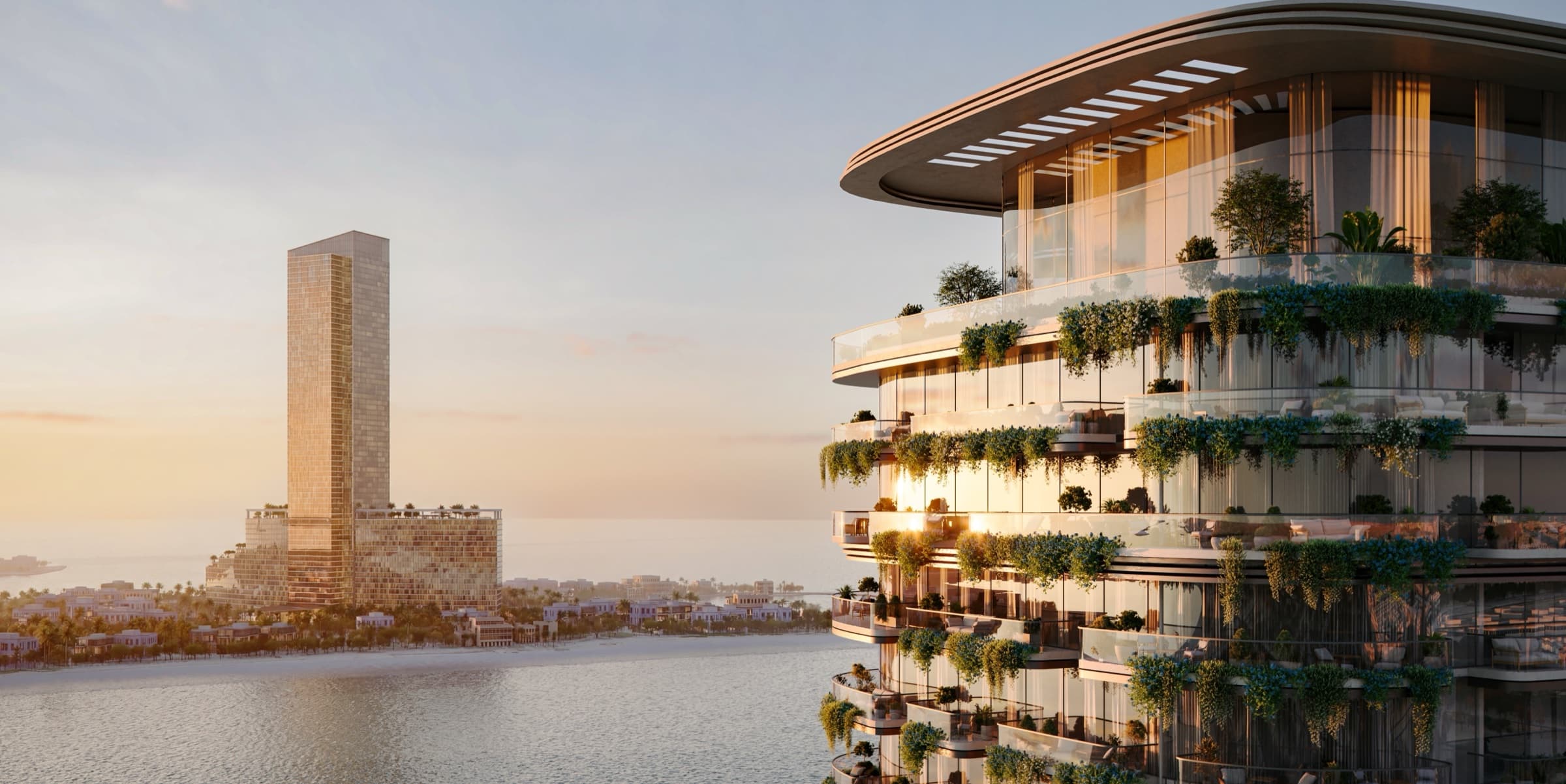
In the ultra-prime segment, OMNIYAT / BEYOND projects on the coastline and at Marasi Bay follow a different rationale: assets are marketed at an estimated AED 15,000–30,000+/sqm, rental volumes are lower, but supply scarcity and architectural distinction support resale appreciation that mass-market product simply cannot replicate.
Choosing Between Rental Yield and Capital Appreciation
The off-plan vs. secondary market split structures this decision directly.
Off-plan: the buyer enters at the developer's price, with staggered payment plans (typically 60/40 or 70/30), which improves the return on deployed equity. The exit occurs at handover or thereafter, with zero tax on realised gains regardless of holding period. The key risks are delivery timing and developer exposure.
Secondary market: the asset is immediately rentable, the rental yield is calculable from signing, and physical due diligence on the unit's condition is possible. Liquidity is strong in established neighbourhoods (Marina, Downtown), with observed resale timelines of 30 to 90 days for correctly priced assets.
For an investor targeting current yield, Business Bay or Dubai Marina on the secondary market remain the most efficient entry points. For an investor focused on capital appreciation over a 5–8-year horizon, the ultra-prime coastal zones backed by BEYOND and emerging areas such as Dubai Islands offer a distinct risk/return profile, justified by land scarcity and the infrastructure pipeline currently underway.
The 7 Steps of the Purchase Process When Buying a Dubai Apartment as a Non-Resident
Buying a Dubai apartment as a non-resident follows a precise sequence, governed by the Dubai Land Department (DLD) and the Real Estate Regulatory Agency (RERA). No step is optional: skipping one exposes the buyer to legal complications or loss of deposit. Below is the actual procedure, in order.
Step 1 — Property selection and RERA verification. Before any negotiation, confirm the property sits in a designated freehold zone. Law No. 7 of 2006 authorises foreign non-residents to hold full ownership in these zones only. (Source: Government of Dubai - Law No. 7 of 2006) Then check the developer on the RERA portal (rera.gov.ae): licence status, registered projects, active escrow accounts. For primary market purchases, request the project's Oqood registration number.
Step 2 — Form F (MOU) and 10% deposit. Once a price is agreed, buyer and seller sign the Form F, the DLD-standardised Memorandum of Understanding. The deposit, typically 10% of the sale price, is paid into an escrow account or by certified cheque. This document is legally binding: a buyer who withdraws forfeits the deposit; a seller who withdraws must return double the amount.
Step 3 — Developer NOC. On the secondary market, the seller must obtain a No Objection Certificate from the original developer confirming no outstanding service charge debt or arrears on the property. This typically takes 5 to 15 business days and costs between AED 500 and AED 5,000 depending on the developer. Without a NOC, the DLD will not process the transfer.
Step 4 — Transfer at the DLD Trustee Office and Title Deed issuance. This is the closing session. The buyer, seller, or their representatives holding a notarised Power of Attorney attend an authorised DLD Trustee office. The balance of the purchase price is settled by manager's cheque or confirmed wire transfer. DLD fees amount to 4% of the purchase price, allocated as per the MOU terms, plus fixed administrative fees of approximately AED 580. (Source: Dubai Land Department - Fees Schedule) The Title Deed in the buyer's name is issued within 24 to 48 hours.
Step 5 — Ejari registration. If you intend to rent the property, registering the tenancy contract on the Ejari platform (managed by RERA) is mandatory. It legally validates the lease, allows the tenant to open a DEWA utilities account, and serves as the reference document for any dispute before the Rental Disputes Center. Ejari fees are approximately AED 220 per registration.
The MOU (Form F) in Practice
The Form F is a standardised template, downloadable from the DLD portal. It sets out the price, transfer date (typically 30 days), DLD fee allocation, and default conditions. Negotiating who bears the 4% DLD fee is common: in a seller's market, the buyer absorbs the full amount; in a more balanced market, a 50/50 split is possible. This agreement should be documented in the Form F itself, not in a separate email.
The deposit cheque is made out to the seller (secondary market) or held in an approved escrow. For transactions above AED 2 million, Golden Visa eligibility should be confirmed immediately: an investment of at least AED 2 million qualifies for the renewable 10-year Golden Visa (Source: UAE Government Portal - Golden Visa), which materially changes the long-term wealth calculation. See our Golden Visa 2026 guide for the structuring steps.
Buying a Dubai Apartment as a Non-Resident Remotely from France
The entire process of buying a Dubai apartment as a non-resident can be completed without the buyer leaving Paris, subject to two conditions. First, a Power of Attorney (POA) must be drafted in English, signed before a notary in France, apostilled under the Hague Convention, then translated and legalised by the UAE MOFAIC. Second, the manager's cheque typically requires either a UAE bank account or an international wire transfer coordinated with the DLD Trustee.
In practice, most French investors make a single trip of 48 to 72 hours for signing and closing, or delegate entirely to a local adviser holding the POA. Level8 coordinates this process end-to-end from Paris, from RERA verification through to Title Deed issuance.
Real Costs: 4% DLD Fees and the Full Budget
Before signing anything, the investor needs a total budget that will consistently exceed the listed price. The line items are well established, but their cumulative effect regularly catches buyers off guard when they have budgeted only the net purchase price.
DLD registration fees represent 4% of the purchase price, plus a Title Deed fee of AED 580 — payable at transfer, not at MOU signing. (Source: Dubai Land Department - Fees Schedule)
By market convention, these 4% are borne by the buyer, unless otherwise negotiated in the MOU. On a property at AED 2 million, that represents AED 80,000 (approx. €21,800) to be budgeted separately from the purchase price.
Ancillary Fees to Factor In
4% of price + AED 580DLD registration fees · DLD Fees Schedule AED 4,000 excl. VATTrustee Office (property > AED 500,000) · DLD / Trustee Network 2% + 5% VATAgency commission · Dubai market practice AED 500 – AED 5,000Developer NOC · Market practice, varies by developerThe Trustee Office is the DLD-authorised desk that physically executes the property transfer. Its fees, capped at AED 4,000 excl. VAT for any property above AED 500,000, are fixed and non-negotiable. The agency commission stands at 2% of the purchase price, subject to 5% VAT, giving an effective rate of 2.1% — generally paid by the buyer on the resale market.
Service Charges: The Recurring Cost Not to Underestimate
Service charges vary significantly by building tier:
- AED 10–20/sq ft/year: standard buildings in areas such as JVC or Sports City
- AED 25–40/sq ft/year: mid-range buildings, Dubai Marina, JLT
- AED 45–60/sq ft/year: signature buildings, Downtown, Palm Jumeirah, DIFC
For a 100 sqm apartment (approx. 1,076 sq ft) in a mid-tier building at AED 30/sq ft, the annual charge comes to approximately AED 32,280 (approx. €8,800). This amount must be deducted from the gross yield to arrive at a realistic net figure.
This calculation illustrates a straightforward sizing rule: budget 6 to 7% above the net seller price to cover all entry costs, excluding financing. It is worth noting that this total remains well below the Paris equivalent, where transfer taxes (notary fees) and combined commissions routinely reach 8 to 10% of the price — on gross yields two to three times lower.
Financing, Fund Transfers, and Banking
For a French non-resident, three financing routes are available. They are not equivalent in terms of speed, cost, or flexibility, and the choice directly determines the signing timeline.
SWIFT Transfer for Cash Payment
Full settlement by international bank transfer remains the simplest and fastest route. The seller or developer receives funds in AED or USD into a UAE account, with no legal cap on the Dubai side. The dirham is pegged to the US dollar at a fixed rate of AED 3.6725 per USD since 1997 (Source: Central Bank of the UAE / IMF), which eliminates EUR/AED currency risk for anyone converting to USD before the transfer. Allow 2 to 5 business days for a SWIFT transfer from a French bank to a UAE bank, depending on KYC compliance checks at the receiving end.
UAE Mortgage for Non-Residents
UAE banks (Emirates NBD, ADCB, and Mashreq, among others) offer home loans to foreign non-residents, but under stricter conditions than for residents.
50–60%Max LTV for non-residents (property ≤ AED 5M) · Emirates NBD / ADCB — 2025 rate cardsInterest rates are generally variable, indexed to 3-month EIBOR, with observed margins of 1.5% to 2.5% above the benchmark. The maximum term is typically 25 years, and the bank will require partial income domiciliation or proof of net worth. The absence of a prior UAE bank account is not a disqualifying factor, but it adds 4 to 8 weeks to the application timeline.
Developer Payment Plans (Off-Plan)
Dubai's off-plan market is built around staggered payment plans that allow buyers to deploy a reduced initial outlay. The most common structure is 20/40/40: 20% at signing, 40% during construction, and 40% at handover. Some developers offer post-handover plans, spreading the final 40% over 3 to 5 years after key handover, which meaningfully improves the investor's cash flow during the rental ramp-up phase.
French Compliance: TRACFIN and DGFiP Reporting
Buying a Dubai apartment as a non-resident does not waive any French tax or reporting obligation. Two points are non-negotiable:
- Form 3916 (or 3916-bis): any bank account opened in the UAE must be declared to the DGFiP in the annual income tax return. The penalty for non-disclosure is €1,500 per undeclared account, rising to €10,000 if the account is domiciled in a non-cooperative jurisdiction — which the UAE is not.
- TRACFIN: a large outbound transfer (above variable thresholds depending on the bank, generally from €150,000 to €500,000) may trigger a source-of-funds request from the French bank. Preparing a source-of-funds file in advance (tax assessments, disposal deeds, portfolio statements) eliminates any friction.
These requirements are manageable with 4 to 6 weeks of lead time. They are not an obstacle to investing — they are simply part of the process, on a par with local legal due diligence.
Tax and Golden Visa: What Buying a Dubai Apartment as a Non-Resident Changes
0% in the UAE, 0% in France: How the 1989 Tax Treaty Works
The UAE levies no tax on rental income or capital gains realised on its territory. This is not a temporary fiscal incentive: it is a foundational feature of the UAE tax system, codified and stable for decades.
The tax treaty signed between France and the UAE in 1989 goes further still. It assigns taxing rights over real estate income to the country where the property is located — i.e., the UAE. As a result, a French tax resident receiving rental income from a Dubai apartment is not taxable in France on that income, since the right to tax it belongs to the UAE, which does not exercise it. The net effect is an effective rate of 0% on both rental income and capital gains, with no offshore structure or aggressive planning — simply by applying the treaty as written.
10-Year Golden Visa: The Threshold and What It Changes in Practice
A real estate investment of at least AED 2 million (approx. €544,000 at the current pegged rate) qualifies for the renewable 10-year Golden Visa, with no minimum stay requirement in the UAE. (Source: UAE Government Portal - Golden Visa)
This visa materially changes the nature of the investment. The holder can open a local bank account without permanent physical residency, facilitate future transactions, sponsor immediate family members, and secure a long-term right of entry and stay in a country with no personal income tax. For an investor who owns a unit in BEYOND or any other signature project above the threshold, the eligibility process is straightforward. The full procedure is set out in the article Golden Visa 2026 — the AED 2M Threshold in Practice.
The AED/USD Peg: An Implicit Currency Hedge
The UAE dirham is pegged to the US dollar at a fixed rate of AED 3.6725 per USD since 1997, a parity maintained without interruption for nearly three decades. (Source: Central Bank of the UAE / IMF)
For a euro-based investor, this means currency risk reduces to the EUR/USD pair, one of the most liquid and well-understood in the world. There is no devaluation risk specific to the UAE currency. Rents collected in AED and converted to EUR fluctuate solely with EUR/USD — a parameter most institutional investors know how to manage or hedge. Combined with the 5% to 8% gross rental yields observed across Dubai's neighbourhoods, this combination of returns and monetary stability has no direct equivalent in Western Europe.
Why Dubai Remains the Best Allocation in 2025
For a French investor accustomed to comparing after-tax net yields, the numbers speak for themselves. Gross rental yields in Dubai sit between 5% and 8% depending on the neighbourhood, versus 2 to 3% in central Paris (Source: REIDIN / Dubai Residential Market Report 2024) — and that is before applying French income tax on property revenue (marginal rate plus 17.2% social levies) or London's stamp duty. In Dubai, the applicable rate on rental income and capital gains remains 0%. The real net gap regularly exceeds 4 to 5 percentage points per year, compounding to a substantial performance advantage over a five-year horizon.
Market liquidity confirms this structural attractiveness. The DLD recorded 1.6 million transactions in 2024, a volume that places Dubai among the most active residential markets in the world, well ahead of markets such as Lisbon or Barcelona, whose transaction volumes remain marginal on an international scale. This depth supports a realistic exit — whether at twelve or thirty-six months — without a meaningful liquidity discount.
A 2025–2027 Delivery Pipeline That Supports Valuations
The upcoming delivery calendar is not an oversupply risk — it is a price catalyst. Projects by OMNIYAT, Emaar, and DAMAC scheduled for delivery between 2025 and 2027 bring high-calibre product to market, attracting solvent international buyers while anchoring price benchmarks in prime neighbourhoods. BEYOND by OMNIYAT, for example, is part of a broader upmarket repositioning that pulls valuations upward rather than diluting them.
The Level8 Recommendation for Tickets above AED 2M
An investment of at least AED 2 million qualifies for the renewable 10-year Golden Visa, with no minimum stay requirement in the UAE. (Source: UAE Government Portal - Golden Visa) For any investor at or above this ticket size, the structure combining a prime freehold acquisition with a simultaneous Golden Visa application is the standard trajectory we recommend: it secures ownership, optimises potential tax residency, and strengthens resale liquidity among buyers who themselves value that status.
Paris offers one thing Dubai cannot yet match at the same scale: a multigenerational wealth market with assets proven over a century. That is the one concession worth making. But for an investor seeking a competitive net yield, a stable currency, zero taxation, and documented liquidity, buying a Dubai apartment as a non-resident in 2025 has no equivalent in the price range accessible to European non-residents. The entry point is now; the repricing of prime zones is already underway.
To go further on Golden Visa structuring or to validate your investment envelope, see our guide Golden Visa 2026 — the AED 2M Threshold in Practice.
Frequently Asked Questions
Can a French citizen consider buying a Dubai apartment as a non-resident without a residency visa?
Yes, without restriction. Law No. 7 of 2006 explicitly authorises foreign non-residents to acquire full freehold ownership in Dubai's designated freehold zones (Dubai Marina, Downtown, Business Bay, Palm Jumeirah, and others). No UAE visa, tax residency, or local bank account is required to sign the deed — a valid passport is sufficient. The Title Deed is issued by the Dubai Land Department directly in the buyer's name, regardless of whether they reside in the UAE.
What are the total acquisition costs on top of the purchase price?
Budget approximately 6 to 7% above the net seller price. The main line items are: 4% DLD registration fees + AED 580 Title Deed, AED 4,000 Trustee Office fee, 2.1% agency commission (2% + 5% VAT), and AED 500–5,000 for the developer NOC on the secondary market. On an AED 2 million property, total entry costs come to approximately AED 129,000 — well below the 8–10% routinely observed on a Paris acquisition.
How is rental income from a Dubai apartment taxed for a French tax resident?
The effective rate is 0%. The UAE levies no tax on rental income or capital gains. The 1989 France-UAE tax treaty assigns taxing rights over real estate income to the country where the property is located — the UAE — which does not exercise that right. A French tax resident is therefore not taxed in France on Dubai rental income, provided the treaty is properly applied. Worldwide reporting obligations remain (Form 3916 for UAE bank accounts) and the situation should be confirmed with a tax adviser specialising in international taxation.
What is the minimum investment to qualify for the 10-year Golden Visa?
AED 2 million (approximately €544,000 at the current pegged rate) in real estate qualifies for the renewable 10-year Golden Visa, with no minimum stay requirement in the UAE. The visa is optional and is not a condition of purchase, but it materially strengthens the investment: easier local banking, family sponsorship, long-term right of entry, and improved resale liquidity to buyers who value the status. The application can be initiated as soon as the Title Deed is issued.
Can the entire transaction for buying a Dubai apartment as a non-resident be completed remotely from France?
Yes. The full process of buying a Dubai apartment as a non-resident — from MOU signing to Title Deed issuance — can be executed from Paris via a Power of Attorney drafted in English, signed before a French notary, apostilled under the Hague Convention, and legalised by the UAE MOFAIC. Most French investors either make a single 48–72 hour trip for closing or delegate end-to-end to a local adviser holding the POA. Level8 coordinates the process from Paris, including RERA verification, fund transfers, and DLD registration.
Is currency risk a concern for a euro-based investor?
No specific UAE currency risk exists. The dirham has been pegged to the US dollar at a fixed rate of AED 3.6725 per USD since 1997 — a parity maintained without interruption for nearly three decades. Currency exposure for a euro-based investor reduces to the EUR/USD pair, one of the most liquid in the world and easily hedgeable. Combined with 5–8% gross rental yields and 0% taxation, this monetary stability is a structural advantage no Western European market can match.
Further Reading
Three complementary reads from the Level8 journal:
- Golden Visa 2026 — the AED 2M Threshold in Practice — The 2024 Golden Visa reform set the threshold at AED 2 million (approx. €500K) with a renewable 10-year visa and no residency requirement. The complete structuring and application guide.
- Marjan Island: The Post-Wynn Equation — Wynn Al Marjan Island opens in 2027 — the Middle East's first integrated resort-casino. What do Macau, Las Vegas, and Atlantic City tell us about real estate repricing after opening day?
- Marina vs Palm — the Yield Gap is Closing — A study of 240 DLD transactions between January 2025 and February 2026 across Dubai Marina and Palm Jumeirah. The yield differential narrowed from 230 basis points to 80.