Key takeaways
- The DFM crossed AED 1 trillion in market capitalisation on 17 June 2026, with the general index at 6,115.97 points — its highest level since 2008.
- Main catalyst: a preliminary US/Iran peace agreement compressed the regional risk premium in a single session.
- 54% of value traded in Q1 2026 came from foreign investors; 79% of new DFM registrations originated from international markets.
- Those same institutional flows are moving into property: premium off-plan and high-end rentals are absorbing the excess liquidity.
- For 2026–2028: prime yields are likely to compress and valuations will stay supported — the entry window remains open on pre-launches, before re-rating is fully priced in.
What happened on the DFM on 17 June 2026?
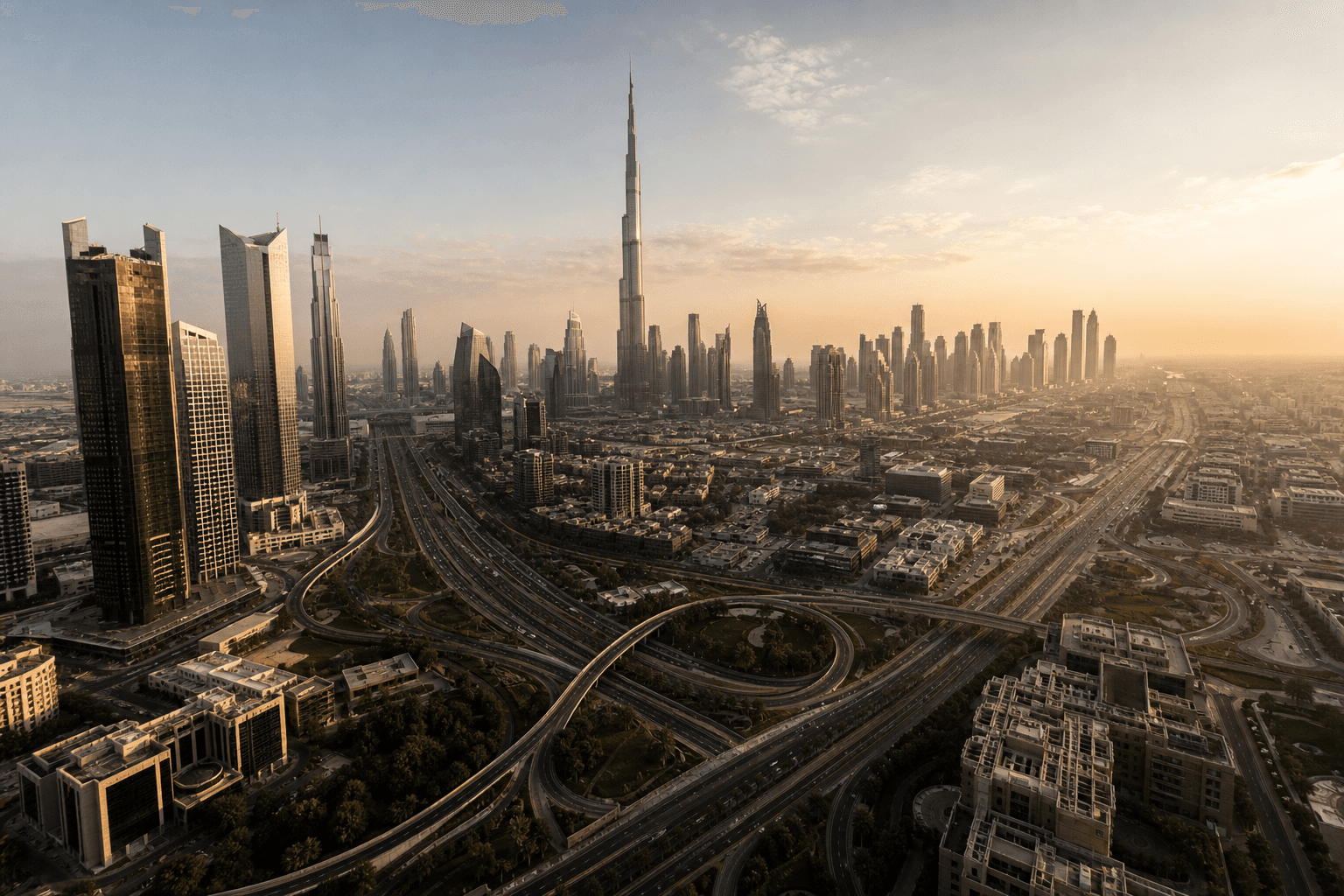
On 17 June 2026, the Dubai Financial Market crossed a threshold many analysts had placed on the 2027 horizon: AED 1 trillion in cumulative market capitalisation, equivalent to roughly USD 272 billion. The milestone was confirmed at close and reported the same evening by Gulf News.
The DFM general index closed at 6,115.97 points that day — its highest level since 2008, before the global financial crisis.
The immediate catalyst is clear: a preliminary peace agreement between the United States and Iran compressed the region's geopolitical risk premium within hours. Buying flows were swift and decisive.
AED 1 TrillionDFM Market Cap — 17 June 2026 · Gulf News, 17 June 2026On the day, the DFM sharply outperformed its Gulf peers — Tadawul (Saudi Arabia), ADX (Abu Dhabi), and the Qatar Stock Exchange — on a daily-return basis. That performance gap points to targeted capital reallocation into Dubai, not a simple regional rising-tide effect.
For real estate investors, the signal is direct. The same reallocation logic pushing capital into the DFM also drives land transactions registered at the Dubai Land Department. Both markets share the same international institutional investor base.
Why does this threshold matter for property?
A stock market record is not just a symbolic figure. It triggers two direct mechanisms in real estate: the wealth effect, which expands the investment capacity of asset holders, and the liquidity effect, which compresses the risk premium applied to all Dubai assets — including bricks and mortar.
In Q1 2026, foreign investors accounted for 54% of total trading value on the DFM. This institutional and HNW pool is the same one absorbing prime off-plan in Dubai.
The buyer profile is confirmed on the registration side: 79% of newly registered DFM investors in Q1 2026 came from international markets, according to the exchange's quarterly report. This is not coincidence. It is the same cross-border capital that, once familiar with Dubai's regulatory environment, naturally migrates into property.
54%Foreign investor share of DFM trading — Q1 2026 · DFM Q1 2026 ReportThe third channel is more technical but equally real. A record market cap signals a credible macro trajectory. That credibility reduces the regional risk premium, which mechanically lowers the discount rate applied to future rental income — and pushes property valuations higher at a constant yield.
For investors comparing Dubai against other destinations, this institutional signal carries real weight. As the Jefferies analysis on the new UAE property cycle shows, major allocators are beginning to direct capital toward the region precisely because that perceived risk has compressed.
Who are these foreign investors, and where do they go in property?
The flows that carried the DFM past the trillion-dirham mark are not anonymous. They come from identifiable profiles: European family offices (France, Belgium, Switzerland), US funds with Gulf exposure, Israeli capital that has grown strongly since 2020, and high-net-worth Indian and British investors long embedded in the Dubai ecosystem.
In Q1 2026, foreign investors represented 54% of total trading value on the DFM — evidence that the exchange's liquidity now rests on a structural international base, not episodic speculative flows.
Typical allocation and target segments
These profiles do not allocate in isolation. The observed split runs 60–70% to equities (DFM, ADX) and 20–30% to prime real estate: Dubai Marina, Palm Jumeirah, Downtown, Business Bay. This is not defensive diversification. It is a coordinated yield strategy across a single, tax-neutral regulatory territory.
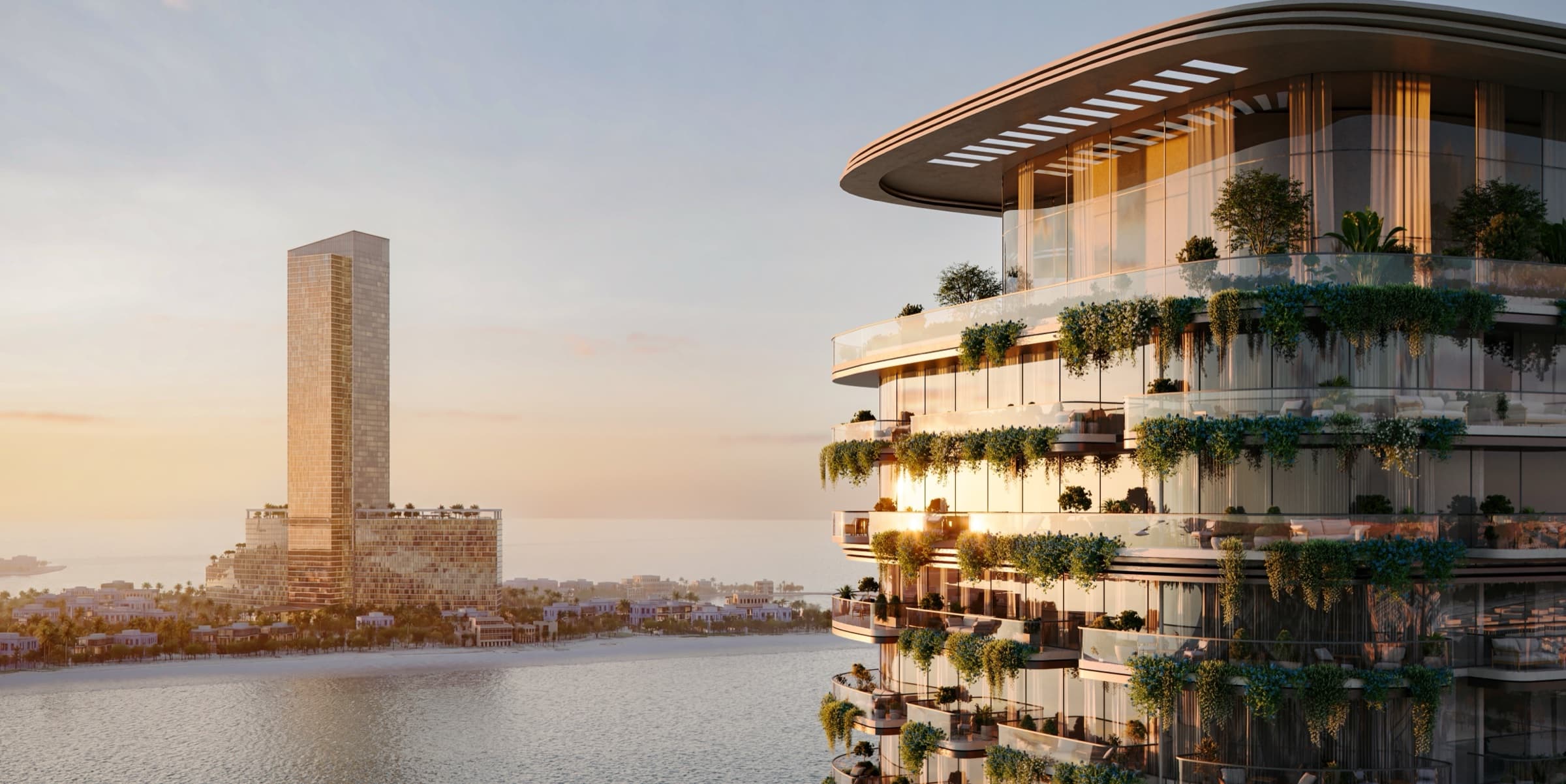
Demand concentrates on signature off-plan: branded residences (BEYOND/OMNIYAT), Palm villas, branded towers delivering in 2027–2028. These assets capture the scarcity premium the secondary market can no longer offer after two years of inventory compression.
On the rental side, the same profiles drive premium demand: AED 25,000 to AED 80,000 per month for two- and three-bedroom apartments in Dubai Marina or Downtown. That rental tension supports gross yields and limits vacancy risk for long-term investors.
The Level8 approach on this segment
This is precisely the segment — signature off-plan, branded residences, direct developer access — that we structure for clients based in France, Belgium, or Switzerland. As direct partners of BEYOND/OMNIYAT, we secure entry at developer pricing with no added fees, and we handle France-UAE tax structuring where needed. Full details on our advisory services are available online.
What is the concrete impact on prices and yields in 2026–2028?
The DFM record does not stay confined to trading floors. The foreign investor flows that pushed market cap to AED 1 trillion simultaneously fuel prime residential demand — both markets draw from the same pool of international capital.
Valuations: base-case scenario
Assuming foreign inflows are sustained, prime valuations should advance +6% to +9% on a rolling 12-month basis. This estimate is consistent with the pace observed since the start of 2026 across Business Bay, Dubai Marina, and Downtown.
5–8%Gross yield range — Dubai residential market 2026 · DLD / Knight Frank Research 2026The rental depth of the Dubai market — underpinned by a structurally growing expatriate population — keeps yields in the 5–8% range despite price appreciation. The Dubai Land Department recorded more than 120,000 transactions in 2025; the 2026 trajectory is tracking the same trend.
Currency effects and risks to watch
For USD or ILS investors, the AED-USD peg provides natural protection against volatility. EUR investors pay a modest currency premium, best managed at the point of entry.
The primary risk is yield compression on ultra-prime — Palm Jumeirah, Emirates Hills — if inflows accelerate. On those segments, gross yield can approach 4%, the threshold below which the rental arbitrage loses its appeal.
The most effective entry window: off-plan pre-launch phases, before post-announcement repricing. This is exactly the type of arbitrage we structure for clients through our projects in direct developer partnerships — at catalogue price, with no additional agency fees.
What should investors do in 2026?
The DFM's AED 1 trillion market cap is not an abstract market signal. It confirms international liquidity — and it reshapes the action timeline for every investor positioned on Dubai.
Five concrete steps, in order
1. Check Golden Visa eligibility. The threshold remains AED 2 million in real estate assets. The window is still open, but prices are moving: every quarter of delay narrows the gap between the entry price and the qualification threshold. The UAE Golden Visa is obtained directly through the DLD for eligible property owners.
2. Prioritise off-plan at pre-launch. The secondary market has already priced in the post-DFM revaluation. Pre-launch projects offer developer pricing with no agency markup — that is where yield delta is created, not by following the market. The AED 275 billion launched in H1 2026 illustrates the scale of the pipeline still accessible.
3. Model the real net yield. Service charges, management fees, vacancy: gross is not net. Our yield calculator lets you compare projects on a like-for-like net basis.
7–8%Observed gross yield — JVC 2026 · DLD / Level8 Research 20264. Recycle already-appreciated assets. A property bought in 2022–2023 has often gained 30–50%. Rather than holding it at a declining yield, a 48-hour cash buy-back lets you redeploy capital into a next-generation programme — no agency fees, no marketing delays.
5. Clarify the France-UAE tax treaty upfront. Dubai rental income is not taxed in the UAE. French, Belgian, and Swiss tax residents must check their country's tax treaty with the UAE. France has a double-tax treaty with the UAE, but Dubai-sourced income remains declarable in France under DGFiP rules — though the effective rate can be reduced. A holding-company structure may change that treatment. This framework must be established before signing, not after.
Further reading
Three complementary reads in the Level8 journal:
- JVC Dubai: the investor guide 2026 (prices, yields, projects) — JVC Dubai in 2026: price per sq ft, gross yields of 7–8%, DLD pipeline, and the zones worth targeting. Data-driven analysis for international investors.
- Jefferies UAE real estate: a new cycle opens in 2026 — Jefferies confirms a new UAE property cycle in June 2026. Abu Dhabi leading, Dubai in entry-window territory, strengthened legal framework.
- Villanova Dubai Properties: investor guide 2026 — Villanova at Dubailand in 2026: price per sq ft, rental yields, delivered phases, and investment arbitrage — backed by DLD data.
FAQ
What is the concrete impact of the AED 1 trillion milestone on Dubai property prices?
The DFM's record market cap compresses the regional risk premium, which mechanically lowers the discount rate applied to future rental income. At a constant rental yield, that compression translates into higher valuations — particularly across prime segments such as Palm Jumeirah, Downtown, and Dubai Marina. DLD data for Q1 2026 already confirms accelerating transaction volumes in signature off-plan.
How are foreign investors taxed on rental income in Dubai?
The UAE levies no income tax on rental income or capital gains for individuals. French, Belgian, and Swiss tax residents must review their country's tax treaty with the UAE. France has a double-tax agreement with the UAE, but Dubai-sourced income remains declarable in France under DGFiP rules — though the effective rate can be reduced. A holding-company structure may alter that treatment.
What gross rental yield can I expect on a prime off-plan apartment in Dubai in 2026?
Observed gross rental yields in 2026 range from 5% to 8%, depending on segment and location. Branded towers (BEYOND/OMNIYAT) and zones such as Dubai Marina or Business Bay sit at the upper end. Secondary-market inventory compression is supporting rents. The net yield calculator at /en/calculateur lets you factor in service charges, DLD fees, and personal tax position to arrive at a true net return.
How do you obtain a UAE Golden Visa through a Dubai property investment?
A real estate investment of at least AED 2 million (approximately USD 545,000) in a DLD-registered property qualifies for a 10-year, renewable Golden Visa. The property may be off-plan, provided the amount paid reaches that threshold. The visa covers the investor, spouse, and dependent children. Applications are processed through the General Directorate of Residency and Foreigners Affairs (GDRFA) after the title is registered at the DLD.
How secure is an off-plan purchase in Dubai, and how does the escrow system work?
RERA regulations require every developer to deposit buyer funds into a dedicated escrow account, supervised by the DLD and controlled by a licensed bank. Funds are released to the developer only in line with verified construction progress, confirmed by an independent inspector. If a developer defaults, the DLD has substitution or refund mechanisms in place. Developers such as BEYOND (OMNIYAT group) operate under these full regulatory obligations.
Is it still a good time to enter the Dubai off-plan market, given the re-rating underway?
The institutional re-rating signalled by the DFM's trillion-AED milestone has not yet been fully priced into pre-launch projects delivering in 2027–2028. The spread between pre-launch pricing and anticipated market value at handover remains positive on signature programmes, according to REIDIN 2026 data. Once this compression cycle is complete, entry windows will narrow. Pre-launches accessible via /en/projets still represent an entry point ahead of full re-rating integration.