
Key takeaways
- Business Bay for a Canadian investor trades at AED 22,000-28,000/m² in 2026, 25 to 40% below Downtown (AED 35,000/m² and up), for a location right next to the financial center.
- Gross rental yield reaches 6.5% to 7.5% in early 2026 per DLD/REIDIN, versus roughly 5.5% in Downtown: a measurable gap, not a rounding error.
- Dubai charges 0% tax on rent and capital gains, but a Canadian tax resident is still taxed by the CRA on worldwide income: the real advantage plays out on gross yield, not on an illusory exemption.
- Purchase happens entirely remotely from Montreal, Toronto, or Vancouver, via an apostilled notarized power of attorney, KYC checks, and a SWIFT transfer to a DLD escrow account.
- Budget from day one for 4% DLD transfer fees plus roughly AED 5,250 in registration, and aim for a ticket of at least AED 2M to unlock the 10-year Golden Visa.
Why Business Bay instead of Downtown for Canadian capital?
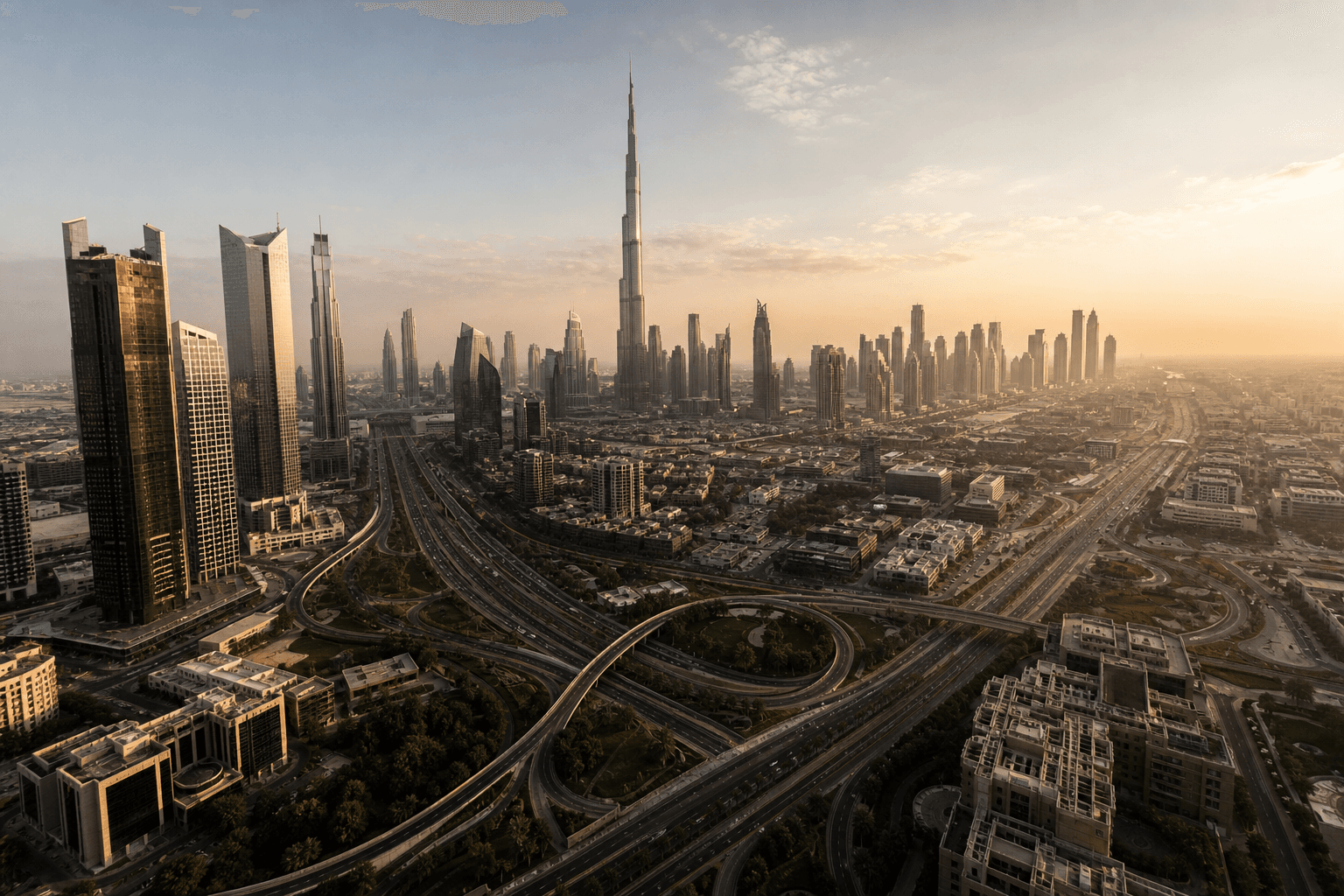
For equivalent invested capital, Business Bay delivers 1 to 2 points more gross yield than Downtown. And it sits right next door. That's the central trade-off for an investor coming from Montreal or Toronto.
6.5-7.5% vs 5.5%Gross yield Business Bay vs Downtown · DLD / REIDIN Q1 2026Business Bay is Dubai's secondary CBD: over 240 mixed-use towers, direct access to Sheikh Zayed Road, and a Business Bay station on the metro's Red Line. The Dubai Water Canal supports dual rental demand: short-term tourist stays on one side, corporate tenants on the other. That demand diversification limits exposure to a single tenant type.
The lower entry ticket also reduces exposure to CAD/AED currency risk on a single asset. A fluctuating Canadian dollar weighs less on a property at AED 25,000/m² than on one at AED 35,000/m² and above. On liquidity, Business Bay ranks among the top 5 most active neighborhoods by transfer volume, per Dubai Land Department data for Q1 2026. That's a key signal for an investor who wants to be able to resell without excessive delay.
What Downtown still has going for it
Downtown remains Dubai's most recognizable address, anchored by Burj Khalifa and Dubai Mall. Its very-short-term tourist rental premium sometimes exceeds Business Bay's, on premium units with direct views. But for a Canadian investor optimizing net yield after conversion and CRA reporting, that prestige gap doesn't offset the gross yield gap at purchase.
Prices, rents and net yield: the 2026 numbers
In Business Bay, a studio trades between AED 950,000 and AED 1,200,000 in early 2026. A one-bedroom unit costs AED 1.4M to 1.9M, depending on floor, canal view, and developer. These levels remain well below Downtown.
AED 22,000 - 28,000Price per m² Business Bay · DLD / REIDIN Dubai Residential Index 2026On rents, a furnished one-bedroom leases between AED 70,000 and AED 110,000 per year, depending on the tower and furnishing level. Against purchase price, the headline gross yield runs around 6.5% to 7.5%.
But gross yield isn't what lands in a Montreal or Toronto bank account. After deducting service charges (roughly AED 15-18/sq ft per year depending on the tower), property management fees (5-8% of collected rent), and an estimated 4 weeks of vacancy per year, real net yield sits between 5.5% and 6.5%. That's the figure to compare against an equivalent Canadian investment, not the gross number listed on portals.
On a trailing twelve-month basis, residential prices in the district are rising roughly +12% in early 2026. A dense pipeline is driving this: over 60 towers set for delivery between 2026 and 2028, according to the Dubai Land Department. That ongoing supply will weigh on rents over the medium term, a factor to build into any 5-to-7-year projection.
Converting to Canadian dollars, honestly
The AED is pegged to the US dollar, not the CAD. In practice, net yield in Canadian currency depends on the USD/CAD rate at purchase, then again at every rent repatriation. Over the past five years, that rate has swung by more than 15% between its low and high points. That gap alone can wipe out a full point of net yield.
Two practical rules limit this risk. First, repatriate rent quarterly rather than annually, to smooth out the average rate. Second, never budget a project on the exchange rate from the day of the simulation. Our net yield calculator lets you test these assumptions in converted CAD, across multiple currency scenarios.
Business Bay, Downtown, Marina: the comparison
| Zone | Price/m² (AED) | Gross yield | 12-month growth | Golden Visa (AED 2M) |
|---|---|---|---|---|
| Business Bay | 22,000 - 28,000 | 6.5 - 7.5% | ~+12% | Yes, from 1 qualifying unit |
| Downtown Dubai | 35,000+ | ~5.5% | more moderate | Yes |
| Dubai Marina | 24,000 - 30,000 | 6.0 - 7.0% | intermediate | Yes |
Business Bay combines a lower entry ticket than Downtown with a higher yield. For a Canadian investor optimizing net returns after conversion and tax, it's the most favorable trade-off among the three zones.
How does a Canadian tax resident report Dubai rental income?
Dubai withholds nothing on rent at source. But a Canadian tax resident remains taxed by the CRA on worldwide income, Emirati rent included. The headline 0% in Business Bay isn't the rate that matters. What matters is the Canadian marginal rate, applied after conversion.
A Canadian tax resident is taxed on worldwide income, which includes rent collected in Dubai, and must report foreign property whose cost exceeds CAD 100,000.
In practice, net rent collected in AED converts to Canadian dollars at the applicable rate. It then gets reported alongside deductible expenses (management fees, maintenance, loan interest where applicable). Since Dubai withholds nothing locally, there's effectively no foreign tax credit to claim: the entire tax burden falls on Canada, with no double taxation, but no relief either.
A property whose cost exceeds CAD 100,000 triggers the obligation to report foreign assets (Form T1135). On resale, the UAE withholds nothing on the capital gain. The gain's tax treatment falls entirely under Canadian rules, whether the property counts as a secondary residence or an investment asset, depending on the structure used.
A point to systematically confirm with a Canadian tax advisor: tax residency status. Leaving Canada, holding non-resident status, or structuring the purchase through a corporation radically changes the equation, particularly around exit tax and capital gains treatment.
And other francophone or American profiles
The mechanism differs by tax residency. A French resident remains covered by the France-UAE tax treaty, with specific treatment for rent and the French wealth tax (IFI). A Belgian or Swiss investor follows different financing and tax rules. For Americans, FBAR and FATCA obligations stack on top of worldwide income reporting, a mechanism detailed in our guide for American investors. In every case, structuring the purchase upfront, before buying rather than after, remains the most effective lever to optimize net yield.
Buying from Montreal or Toronto: the real sequence
An investor based in Montreal or Toronto can acquire a unit in Business Bay without ever setting foot in Dubai. The process relies on a notarized power of attorney signed in Canada, apostilled, then forwarded to the DLD trustee. The KYC file (passport, proof of address, source of funds) accompanies the SWIFT transfer to a registered escrow account. No physical signature is required at any stage.
Expect generally four to eight weeks between reservation and title transfer, depending on the developer's responsiveness and the issuing bank. The 8-hour time difference between Montreal and Dubai actually works in the Canadian buyer's favor. Scheduling bank calls and signatures in the Quebec morning lets you deal with Dubai in its late afternoon local time, with no late-night calls required.
4% + ~AED 5,250 registrationDLD transfer fees · Dubai Land DepartmentOn a AED 2M property, that represents roughly AED 85,000 in friction costs, to budget on top of the purchase price. The full breakdown of these fees, line by line, is detailed in our analysis of acquisition costs in Dubai.
A local bank account isn't mandatory to sign, but it significantly simplifies collecting rent and paying homeowner association charges. Another mechanical effect of the AED 2M threshold: it unlocks the 10-year Golden Visa, extendable to a spouse and dependent children, an advantage that carries real weight against other jurisdictions.
Which off-plan projects to target, and where's the risk?
The Dubai Land Department lists over 60 residential towers set for delivery between 2026 and 2028 within the Business Bay perimeter. Supply splits clearly into two tiers, each with a different risk profile for a buyer based in Montreal or Toronto.
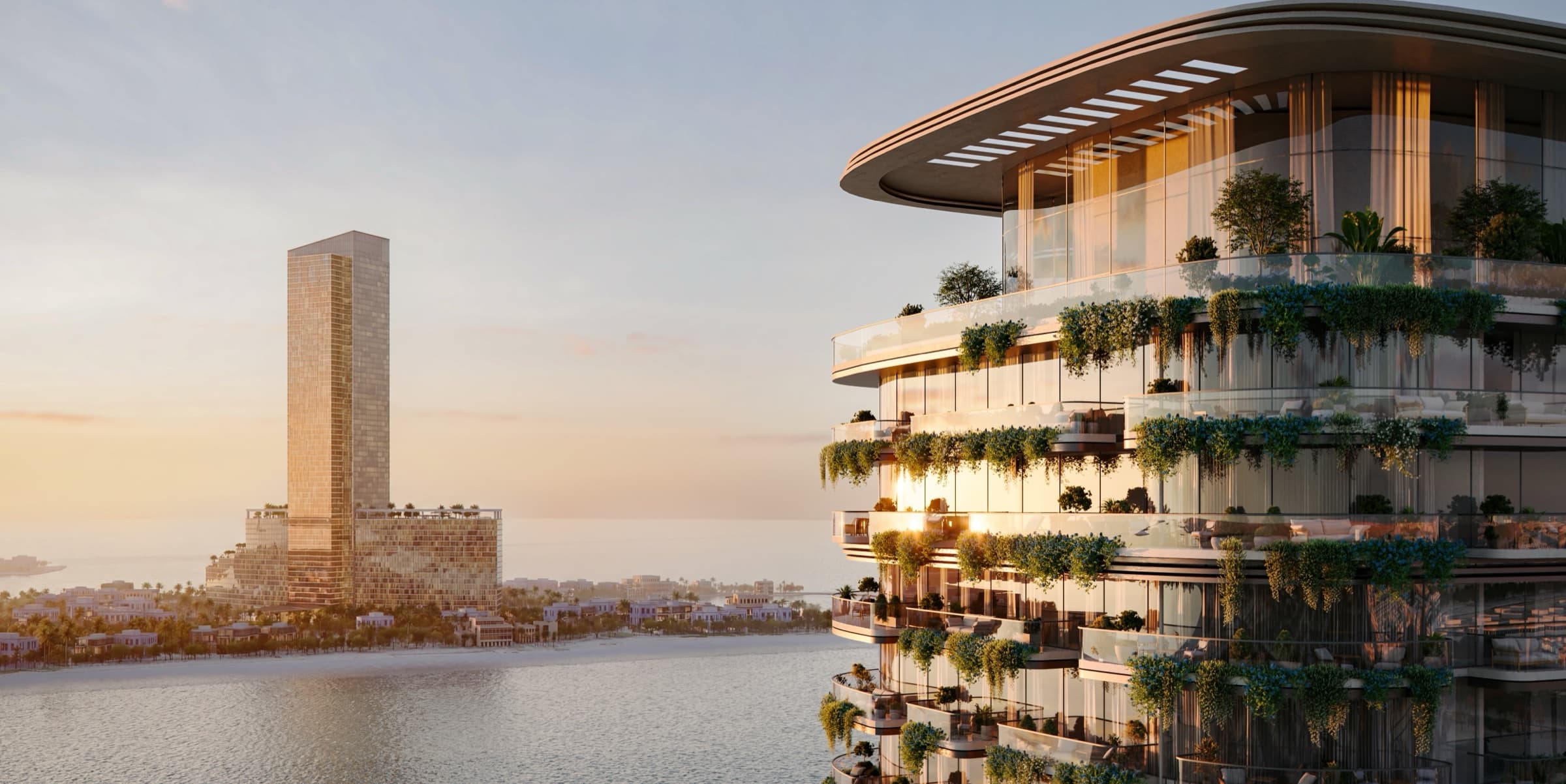
The premium segment includes OMNIYAT and BEYOND signature developments, with tickets starting around AED 2.5M. That threshold also opens the door to the 10-year Golden Visa. Deliveries there are staggered between 2026 and 2028. The mid-market segment starts as low as AED 900,000 for a studio or one-bedroom from Sobha, Damac, or Binghatti. That's a more accessible entry point for a first Canadian allocation, though with proportionally heavier service charges once the tower is delivered.
60/40 or 50/50 post-handover payment plans have become the norm in 2026. In practice, that means less cash tied up during construction, a real advantage for a buyer converting CAD in tranches rather than in a single payment exposed to the exchange rate on one given day.
Buying at developer price, with no markup
Two checks are non-negotiable before any reservation: the project's escrow account must be registered with the DLD, and the developer must show a verifiable RERA track record on previous deliveries. This is exactly the kind of due diligence we run for our Canadian clients remotely, before reservation. See our selected projects in Business Bay, including The Opus and Peninsula Four, The Plaza.
Real blind spots remain: the density of 2026-2028 deliveries will pressure short-term rents in the least differentiated towers, and premium service charges can shave 0.5 to 1 point off net yield.
Verdict: does Business Bay deserve Canadian capital in 2026?
Yes, for a Canadian investor targeting steady cashflow. Business Bay posts gross yield of 6.5% to 7.5%, versus 5.0% to 6.0% in Downtown. After CRA reporting, observed net yield generally sits around 5.5% to 6.5%. It's a liquid CBD, right next to Downtown, backed by a pipeline of over 60 towers delivering by 2028.
The entry ticket, 25 to 40% below Downtown, changes portfolio mechanics. Instead of a single studio in a prestige address, equivalent capital often buys two units in Business Bay. Two leases, two tenants, vacancy risk spread more evenly.
Another structural advantage: the total absence of local withholding on rent or capital gains. Just one tax jurisdiction to manage, the Canadian one. No withholding at source in the UAE, no cross-border reporting to reconcile, no foreign tax credit to calculate since no tax was paid locally in the first place.
What Business Bay doesn't solve: a Canadian tax resident stays taxed on worldwide income as long as Canadian residency is maintained.
A Canadian tax resident is taxed by the CRA on worldwide income, Dubai rent included, and must report any foreign property exceeding CAD 100,000 in cost
. Dubai's 0% doesn't erase Canadian tax liability, it just simplifies the bookkeeping.
Where it's less relevant: an investor seeking a seasonal pied-à-terre with sea views. For that use case, Palm Jumeirah remains superior, despite a lower rental yield.
Concrete next step: run the real net figure through the yield calculator, then decide between a premium channel like The Opus and a mid-market asset like The EDGE, depending on your intended holding period.
Go further
Three related reads from the Level8 journal:
- Dubai vs Cyprus vs Greece: where should Israeli investors buy in 2026? — Yield, tax, visas, access from Tel Aviv, risk: comparing Dubai, Cyprus, and Greece for an Israeli investor in 2026.
- Buying property in Dubai: what does it really cost for AED 1M? — DLD 4%, agency 2%, trustee, NOC, mortgage registration: the true acquisition cost in Dubai in 2026, broken down for AED 500K, 1M, and 3M.
- Why Gulf family offices are leaving London for Dubai — Heavier UK taxation, non-dom reform, wealth tax: Gulf family offices are deserting London and repositioning capital toward Dubai and Abu Dhabi.
FAQ
How does a Canadian tax resident report Dubai rental income to the CRA?
The CRA taxes worldwide income for any Canadian tax resident, including rent collected in Dubai. Net income (after expenses), converted to CAD at the applicable exchange rate, must be reported on Form T776. No foreign tax credit applies since Dubai withholds nothing at source.
What total budget should you plan for buying in Business Bay from Canada?
On top of the purchase price, add roughly 4% in DLD transfer fees plus about AED 5,250 in registration costs. For a studio at AED 1,000,000, budget a total close to AED 1,045,000, excluding property management or agency fees.
How can you buy a property in Dubai without traveling from Montreal or Toronto?
Remote purchase runs through an apostilled notarized power of attorney, a KYC verification, then a SWIFT transfer to a DLD-regulated escrow account. This is the standard process used by most international buyers who never visit Dubai before signing.
What investment ticket unlocks the 10-year Golden Visa in Business Bay?
A real estate investment of at least AED 2,000,000 unlocks eligibility for the renewable 10-year Golden Visa, from a single qualifying unit. In Business Bay, that threshold typically corresponds to a two-bedroom property or larger, depending on floor and tower.
Is the 6.5-7.5% gross yield in Business Bay representative of real net yield?
No. After deducting service charges, property management fees (5-8%), and estimated vacancy, real net yield sits closer to 5.5% to 6.5%. That's the net figure, converted to CAD, to compare against an equivalent Canadian investment.
Why does the USD/CAD exchange rate affect a Canadian investor's returns in Dubai?
The AED is pegged to the US dollar, not the Canadian dollar. Net yield in CAD therefore depends on the USD/CAD rate at purchase and at every rent repatriation, a rate that has swung more than 15% over five years between its low and high points.
Sources
The figures and rules quoted in this article come from the following sources :